AI Interior Design for Rugs: The Size It Always Gets Wrong
A rug is the second largest surface in most living rooms and the one people most often buy too small. It is an easy mistake to make, because the too-small rug looks perfectly reasonable rolled out in a shop and perfectly wrong once it is home, and by then it has your sofa standing on it.
This is exactly the sort of decision a render should be able to settle. And it half does. The half it handles is colour, pattern and texture against your actual floor. The half it does not handle is the rectangle, and the rectangle is where the money is.
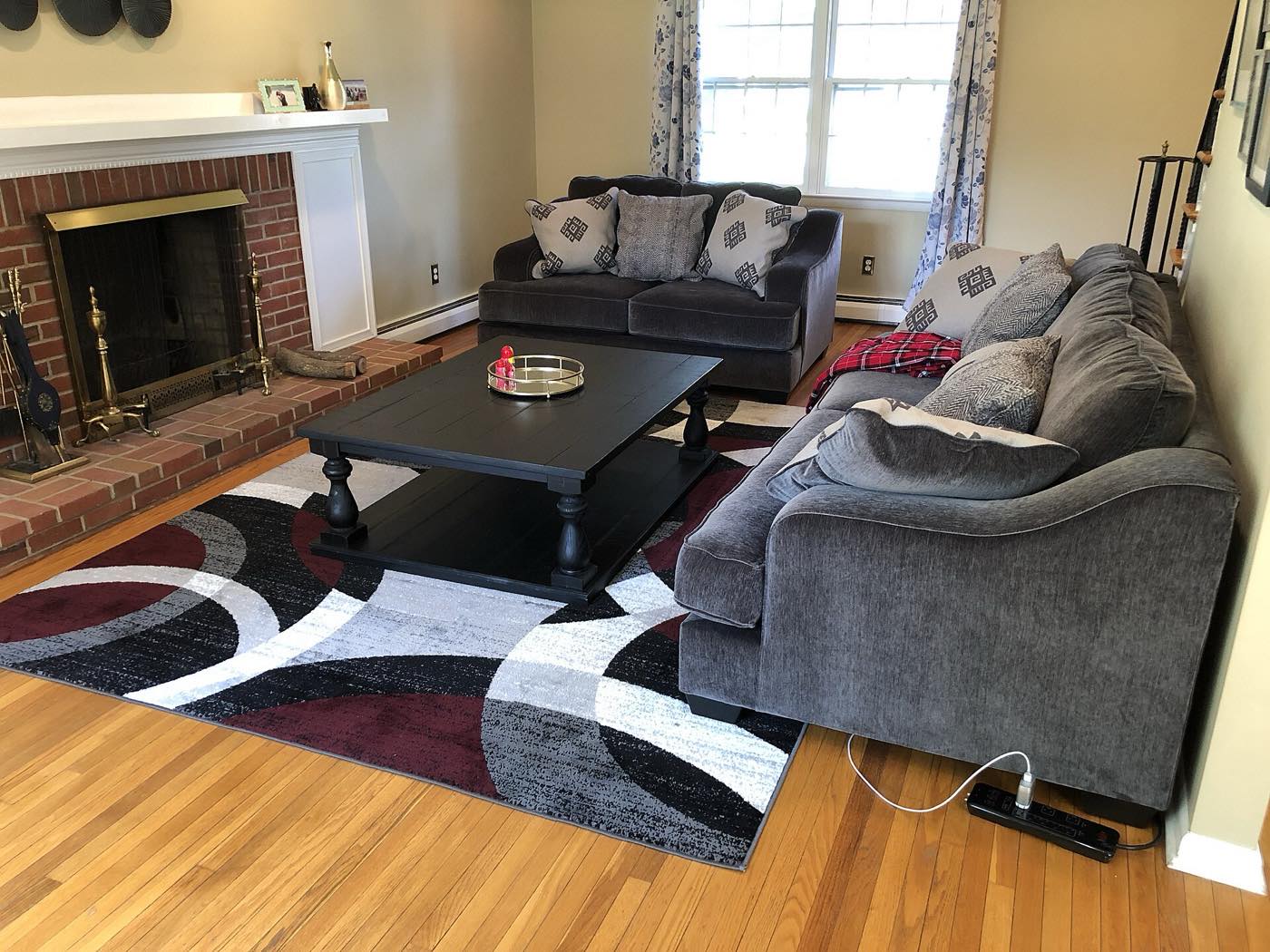
A real room, and a very common outcome. The rug ends where the sofa begins, so the seating group never quite pulls together.
The numbers a rug render never carries
Size, which is not a style choice. There are three sane answers in a living room. All legs on, which needs roughly 240 x 340 cm for a normal three-seater and a pair of chairs. Front legs on, which is the usual compromise and lands around 200 x 300 cm. Or a deliberate small rug that anchors the coffee table alone, which works in a tiny flat and almost nowhere else. A render picks none of these. It draws a rectangle that balances the picture, and the picture is usually shot from a height and an angle you will never stand at.
Placement, which decides whether the room reads as one thing. The rug has to be at least as wide as the sofa, and preferably 15 to 30 cm wider each side. If the sofa is wider than the rug, your eye reads two separate objects and the room feels cheap no matter what you spent. This is the single most common rug error in real homes and renders repeat it faithfully because they are trained on photographs of real homes.
The floor you leave showing. A rug should stop 20 to 45 cm short of the walls, so there is a visible margin of floor framing it. Less than that and it looks like failed fitted carpet. More than that in a small room and the rug stops doing its job. Renders fill floors edge to edge or float rugs randomly in the middle, because neither reading costs them anything.
Pile height and total thickness. An internal door usually clears the floor by 8 to 15 mm. A shaggy rug with a 20 mm pile plus a 5 mm underlay does not fit under it, and you find this out while holding one end of a very heavy roll. Renders have no concept of thickness at all, which is also why they put deep-pile rugs under dining tables, where chair legs sink in and the whole thing becomes a plate-catching sponge.
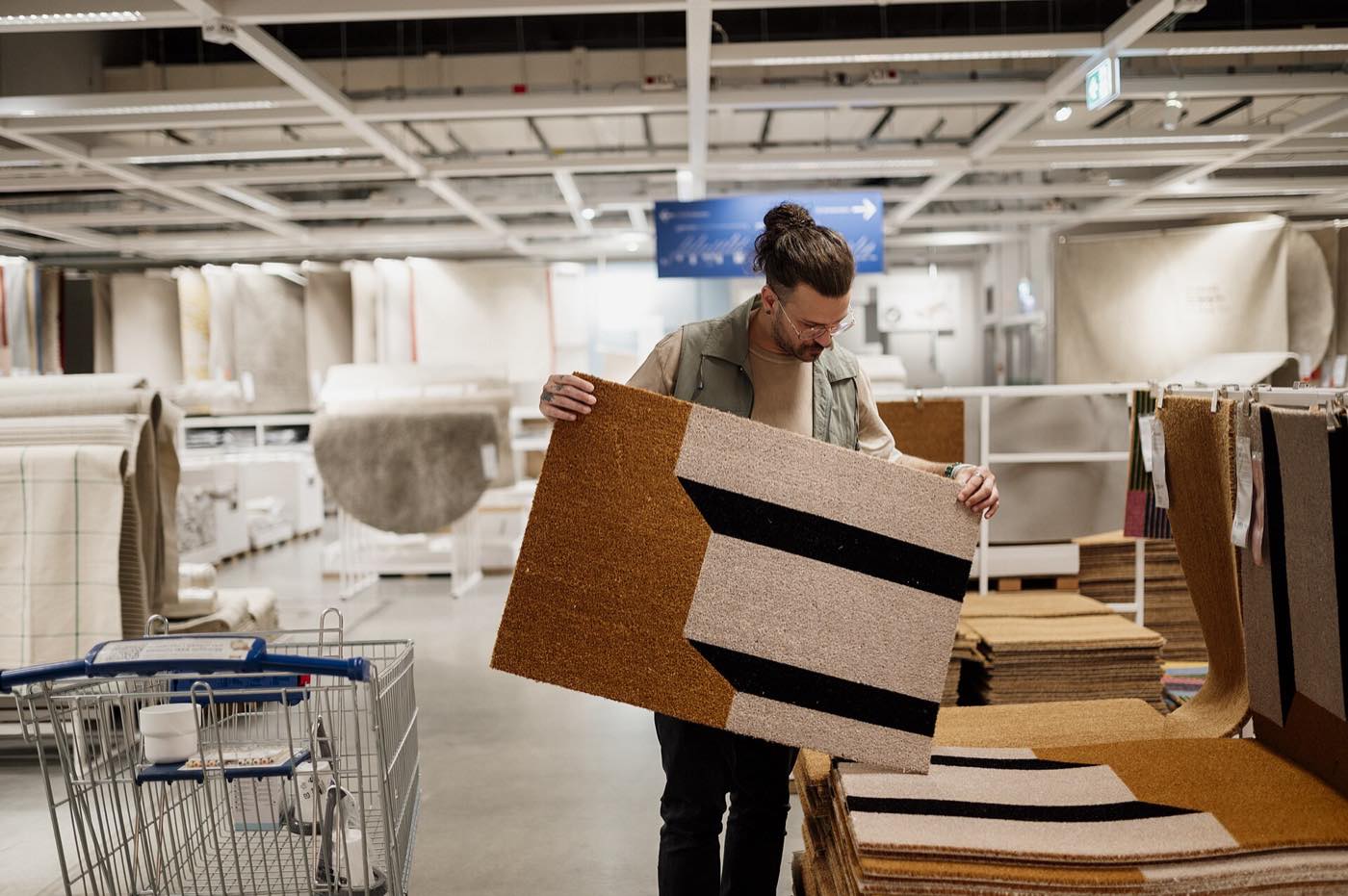
The shop version of the problem. Held up vertically, under fluorescent light, at arm's length, a rug tells you almost nothing about how it will read lying flat in your room.
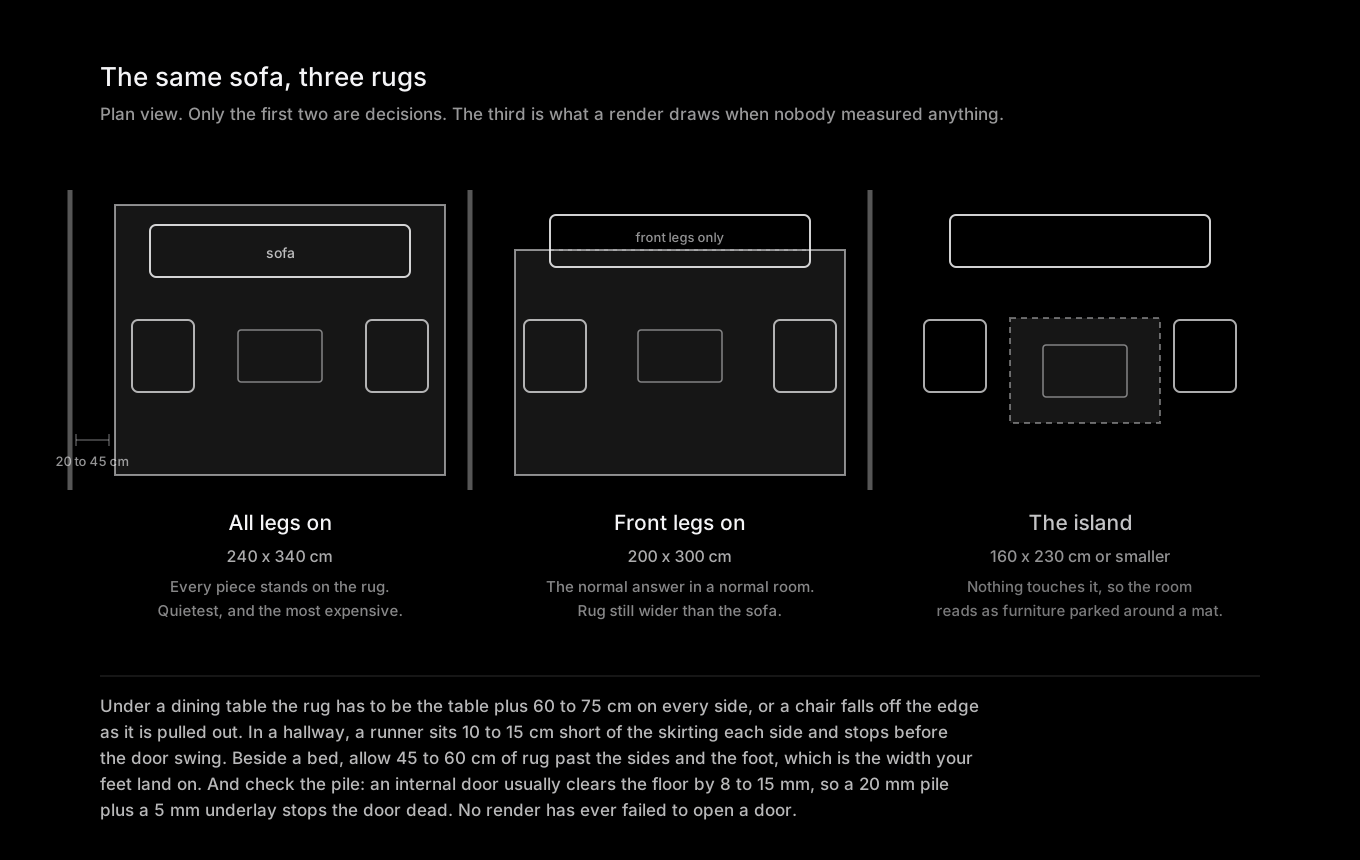
The same seating group, three rugs. Two are decisions. The third is what you get when nobody measured.
Where AI actually earns its time
Once you accept that the size comes from a tape measure, the rest of the rug decision is visual, and this is where a restyle of your own photo beats anything else available to you.
Colour against your floor, not against a shop floor. A rug lives on top of another surface, and its relationship with that surface is the whole game. A warm oak floor kills some greys and makes others sing. Grey porcelain tile does the opposite. No amount of swatch-staring answers this, and a render of your own room answers it in about ten seconds. If you are also weighing up the floor itself, that decision runs on the same logic as an AI flooring visualiser.
Pattern scale. Whether a pattern is too busy for your room is a proportion question, and proportion is one of the few things renders genuinely convey. A large medallion in a 3 x 4 metre room reads completely differently to the same design in a 5 x 6. Generate both, look at them small, on your phone, from across the kitchen. That squint test is more honest than staring at a product page.
Contrast level. The real question in most rooms is not "which rug" but "how much contrast do I want on the floor". A pale rug on a pale floor calms a room and shows every crumb. A dark rug anchors and shrinks. Seeing three versions of your own room settles an argument that otherwise runs for a month.
Texture, at a coarse level. Flatweave, loop, shag and hand-knotted read as different amounts of visual weight, and a render gets that broad difference right. It does not get the actual surface right, and it certainly cannot tell you how a wool loop feels under a bare foot in February.
That demo is the whole method in ninety seconds. One room, held constant, with the rug swapped over and over. The value is not any single image, it is the comparison, because a rug decision is always relative to the floor and the sofa you already own.
The failure modes, so you can spot them
The floating island. The classic. A small rug under the coffee table with the sofa, the chairs and everything else on bare floor. It is the most photographed rug mistake in the world, so the models learned it thoroughly.
Perspective that flatters. Rugs are drawn in a plane the model half understands. Look at where the rug edge meets the skirting on both sides of the room. If the two edges imply different vanishing points, the rug in that image has no real dimensions, and any size you infer from it is invented.
Patterns that cannot exist. A bordered rug has a border that runs all the way round and meets itself at the corners. Renders produce borders that fade out, change width, or turn a corner into a different motif. Same for repeats: a Persian design has a mirrored, repeating structure, and a model that hallucinates one detail per square metre cannot hold that structure across a whole rug.
Dining chairs half off. Ask for a dining room and you will get a rug that ends more or less at the table edge. Sit down at that table in real life and the back legs of your chair drop off the rug every time you stand up. The number is 60 to 75 cm of rug beyond the table on every side, and no render has ever respected it. It is the same blind spot that makes renders seat six people at a table with edge for four, which we measure out in AI dining room design.
A rug that changes the room. If the sofa moved, the room got wider, or the window shifted while you were only asking about a rug, then the model rebuilt the room instead of restyling it. That is the same failure we cover in can AI redesign a room without changing the layout, and once it has moved your furniture, nothing else in the image is about your home.
A rug render answers "does this belong in this room". It does not answer "will my sofa stand on it". Only one of those has a picture as the answer.
How to get a rug render you can act on
Photograph the room from a corner, standing, at about eye height, using the 1x lens rather than the ultra-wide, because a wide lens stretches floors and makes every rug look bigger than it is. Get the sofa and at least two walls in frame so the model has something fixed to hold on to. Then restyle only the rug and change nothing else, so you are comparing rugs and not comparing rooms.
Now do the part no software can do for you. Take masking tape and mark the actual rectangle on the floor, or lay out newspaper, and live with it for a day. Walk the route from the door to the sofa. Pull a chair out. Open the door that swings over it. This takes fifteen minutes and it is the only step that reliably prevents a return.
Then buy from the standard sizes rather than the render's imagination. Most of the market sells 160 x 230, 200 x 300 and 240 x 340, plus runners around 80 cm wide, and a rug that has to be made to measure costs several times what the picture implied.
Questions people ask about AI and rugs
Can AI tell me what size rug I need?
No, and this is the one thing worth being blunt about. Image models have no dimensions, so the rug in a render is sized to suit the picture. Measure your seating group instead, add 15 to 30 cm each side of the sofa, and check the result against standard sizes. The short version of why renders fail at this lives in our answer on why the rug in an AI render is the wrong size.
Can AI show me a specific rug I found online in my own room?
Sometimes, and with caution. If you restyle your photo and describe the rug closely, you will get something in the right family of colour and pattern, which is useful for the contrast decision. You will not get that product. The pattern will not match the repeat, and the size will not match the listing. Treat it as a mood test, not a product preview.
What about a runner in a hallway?
Same rules, tighter tolerances. Leave 10 to 15 cm of floor each side, so in a typical 90 to 100 cm hallway you are looking at a runner around 70 to 80 cm wide, and stop it short of any door swing. Corridors are the space AI distorts most reliably, which we go into in AI interior design for narrow hallways.
Will the colour in the render match the rug that arrives?
Roughly, and only roughly. Renders bake the room's lighting into the colour, so a rug shown in a sunlit render will look several shades duller in a north-facing room in November. Use the render to choose between light and dark, warm and cool, busy and plain. Then order a sample if the seller offers one, and look at it lying flat on your own floor rather than held up in your hand.
The honest position: a rug is a picture problem and an arithmetic problem stacked on top of each other, and AI only solves the picture. Use it to kill the ten rugs that were never going to work in your room, which is genuinely the hard part. Then measure, tape out the rectangle, check the door, and order the size rather than the image. If paint or pictures are next on the list, the same split applies in AI paint colour visualisers and in hanging art and gallery walls.
Image credits: "A Corvara Sofa and Loveseat with a Mallacar Rectangular Cocktail Table in the living room of a house along Aquetong Lane, Ewing Township, New Jersey" by Famartin, licensed CC BY-SA 4.0; "Shopping for decorative rugs at a home furnishings store" by Shixart1985, licensed CC BY 2.0, via Wikimedia Commons. Diagram by MeltFlex Solutions.