What Size Rug Under a Bed? Queen and King, Drawn to Scale
 Braňo Hrivňák
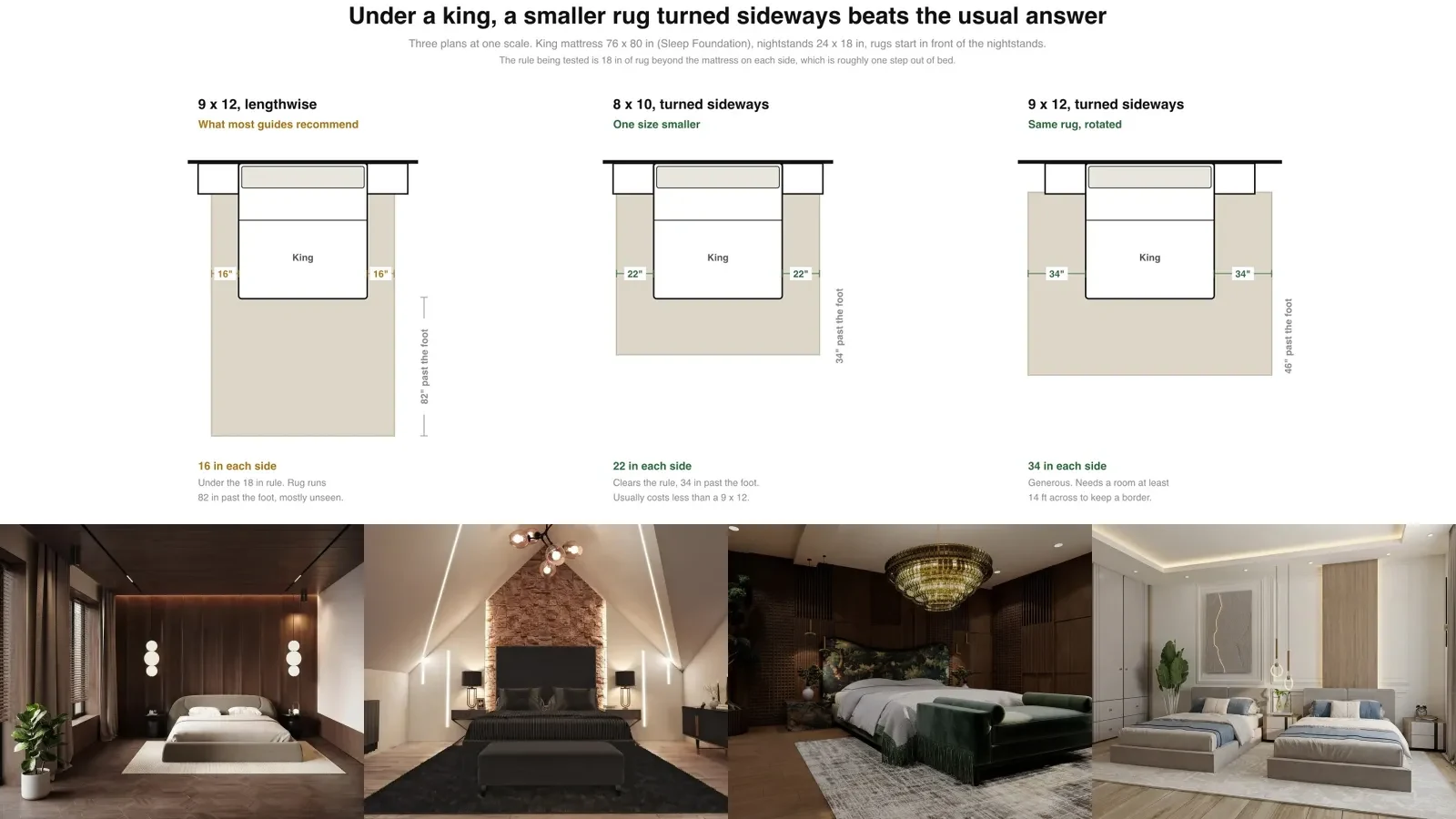
The second half of that answer is the part most rug guides miss. They all lay the rug lengthwise, parallel to the bed. We drew every combination to scale from published mattress sizes, and rotating the rug 90 degrees changes the answer more than going up a size does. Under a king, the 9 x 12 that almost everyone recommends leaves 16 inches a side. A smaller, cheaper 8 x 10 turned sideways leaves 22.
The short version
- Queen: 8 x 10. 18 in a side lengthwise, 30 in a side turned sideways. A 9 x 12 against the wall fits the bed and both nightstands exactly.
- King: 8 x 10 sideways (22 in a side) or 9 x 12 sideways (34 in). The 9 x 12 lengthwise most guides give you leaves 16 in.
- 6 x 9 and 5 x 8 only work under a queen when turned sideways. Lengthwise, a 5 x 8 is exactly as wide as the mattress.
- Start the rug in front of the nightstands unless it is big enough for them to stand on it completely. Never two legs on, two off.
- Leave 12 to 18 in of bare floor to the walls. Your bedroom’s width, not the bed, sets the biggest rug you can use.
The short answer for every bed size
Mattress sizes are standardized, which is what makes this a question with exact answers. The Sleep Foundation lists a twin at 38 x 75 inches, a full at 54 x 75, a queen at 60 x 80, a king at 76 x 80 and a California king at 72 x 84. Our guide to whether a bed actually fits your room covers the walking space around each size. Subtract the mattress width from the rug width, halve it, and you have the rug showing on each side. That is the only number in this article, worked out for every combination people actually buy.
| Bed | Mattress | Best rug | Rug each side | Also works |
|---|---|---|---|---|
| Twin | 38 x 75 in | 5 x 8 sideways | 29 in | 4 x 6 sideways (17 in) |
| Full | 54 x 75 in | 6 x 9 sideways | 27 in | 5 x 8 sideways or 8 x 10 lengthwise (21 in) |
| Queen | 60 x 80 in | 8 x 10 | 18 in lengthwise, 30 in sideways | 9 x 12 (24 in), 6 x 9 sideways (24 in) |
| King | 76 x 80 in | 8 x 10 sideways | 22 in | 9 x 12 sideways (34 in), 10 x 14 lengthwise (22 in) |
| Cal king | 72 x 84 in | 8 x 10 sideways | 24 in | 10 x 14 lengthwise (24 in), 9 x 12 lengthwise (18 in) |
“Sideways” means the long side of the rug runs along the headboard wall, across the bed, instead of from the headboard toward the foot. If you are choosing the rug from an AI render rather than a tape measure, read why AI interior design gets rug size wrong first.
Queen beds: every size people try
A queen is the most common bed in American bedrooms, and the searches show it: people ask about a 5 x 7, a 5 x 8, a 6 x 9, an 8 x 10 and a 9 x 12 under one. Here are all five at the same scale, with nightstands drawn at 24 x 18 inches.
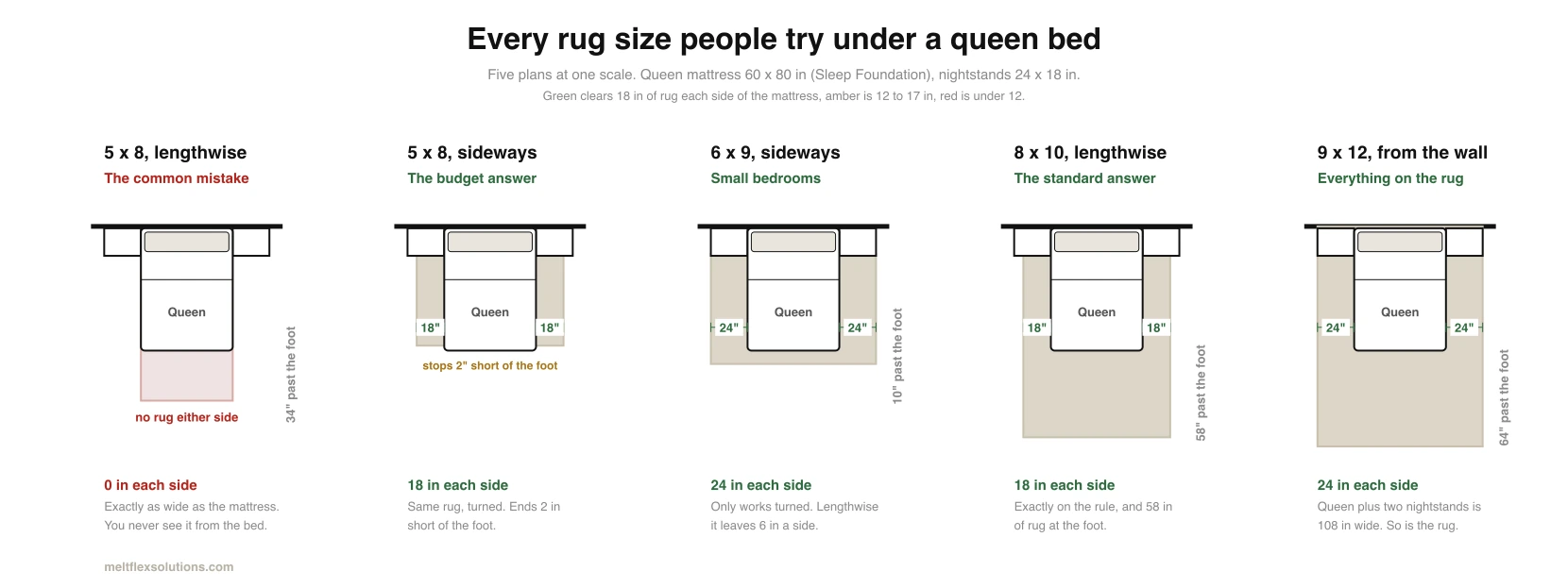
Same bed, five rugs. The first two panels are the same 5 x 8. Lengthwise it vanishes under the mattress; turned sideways it clears the 18 inch rule.
8 x 10 lengthwise is the standard answer, and it holds up. At 96 inches wide it leaves exactly 18 inches either side of a 60 inch mattress, and started just in front of the nightstands it runs 58 inches past the foot. If you were wondering whether an 8 x 10 is too big for a queen, it is not. It is the size the arithmetic points to.
A 9 x 12 against the wall is the upgrade. A queen plus two 24 inch nightstands is 60 + 24 + 24 = 108 inches. A 9 x 12 is 108 inches wide. The whole group stands on the rug, which reads as one deliberate piece rather than a bed parked on a mat. It needs a bedroom at least 11 to 12 feet wide to keep a border of bare floor. (How tall those nightstands should be is in our standard table height guide.)
6 x 9 and 5 x 8 are only worth buying if you turn them. Lengthwise, a 6 x 9 leaves 6 inches a side and a 5 x 8 leaves none, because 60 inches is exactly the width of the mattress. That is why so many people put a 5 x 8 under a queen and decide it looks wrong. Turned sideways, the 6 x 9 leaves 24 inches a side and still ends 10 inches past the foot, and the 5 x 8 leaves 18 inches a side and stops 2 inches short of the foot. Slide the 5 x 8 down to sit under the lower half of the bed and it clears the foot by 24 inches, which is the budget placement in the next section.
A 5 x 7 is too small as the main rug. Turned sideways it is 84 inches across, which leaves 12 inches a side. That is livable but under the rule, and for very little extra money a 5 x 8 does the job properly.
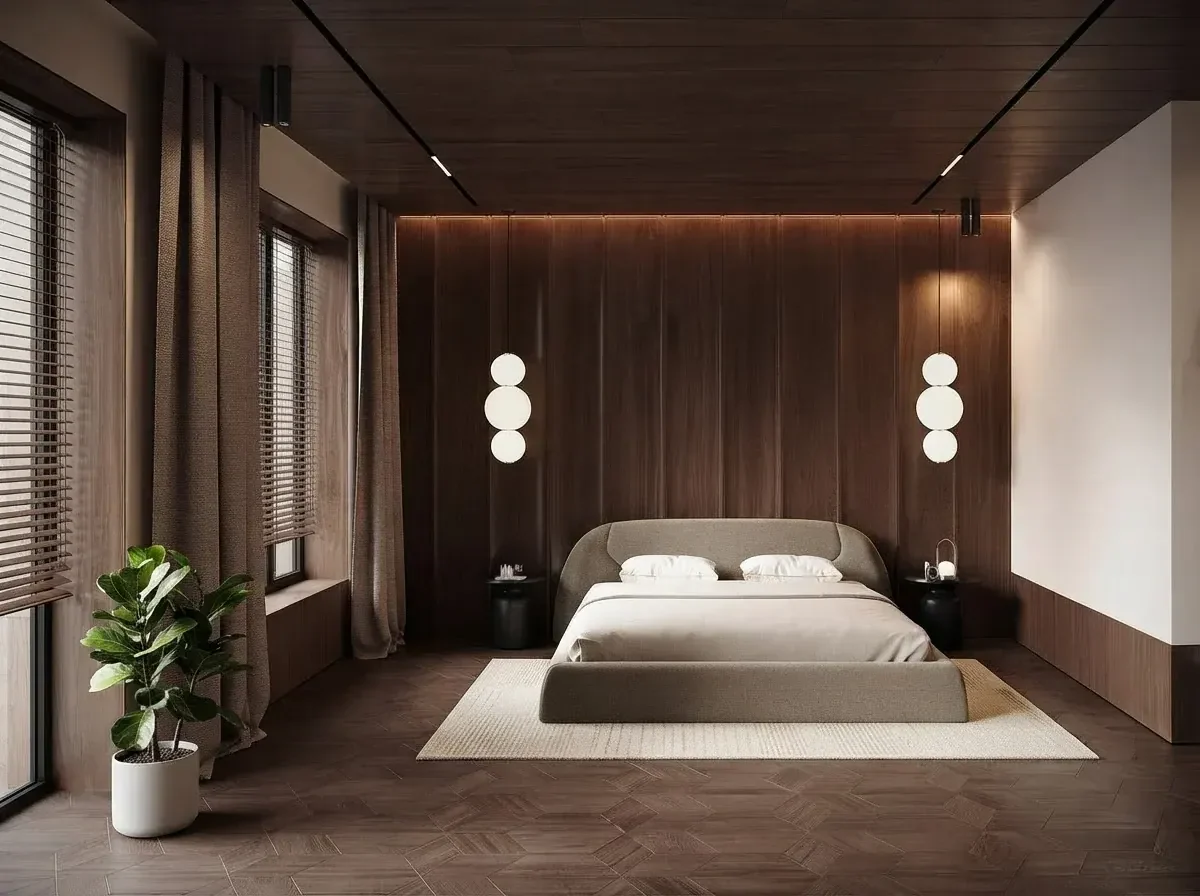
The placement most bedrooms should use: the rug starts in front of the nightstands and runs well past the foot. Rendered in MeltFlex.
King beds: turn the rug sideways
This is where the usual advice quietly fails. Search “what size rug for a king bed” and the most common answer is a 9 x 12. A king is 76 inches wide. A 9 x 12 laid lengthwise is 108 inches wide. That leaves 16 inches a side, under the 18 inch rule the same guides quote a paragraph earlier, while most of the rug runs 82 inches past the foot of the bed where nobody stands.
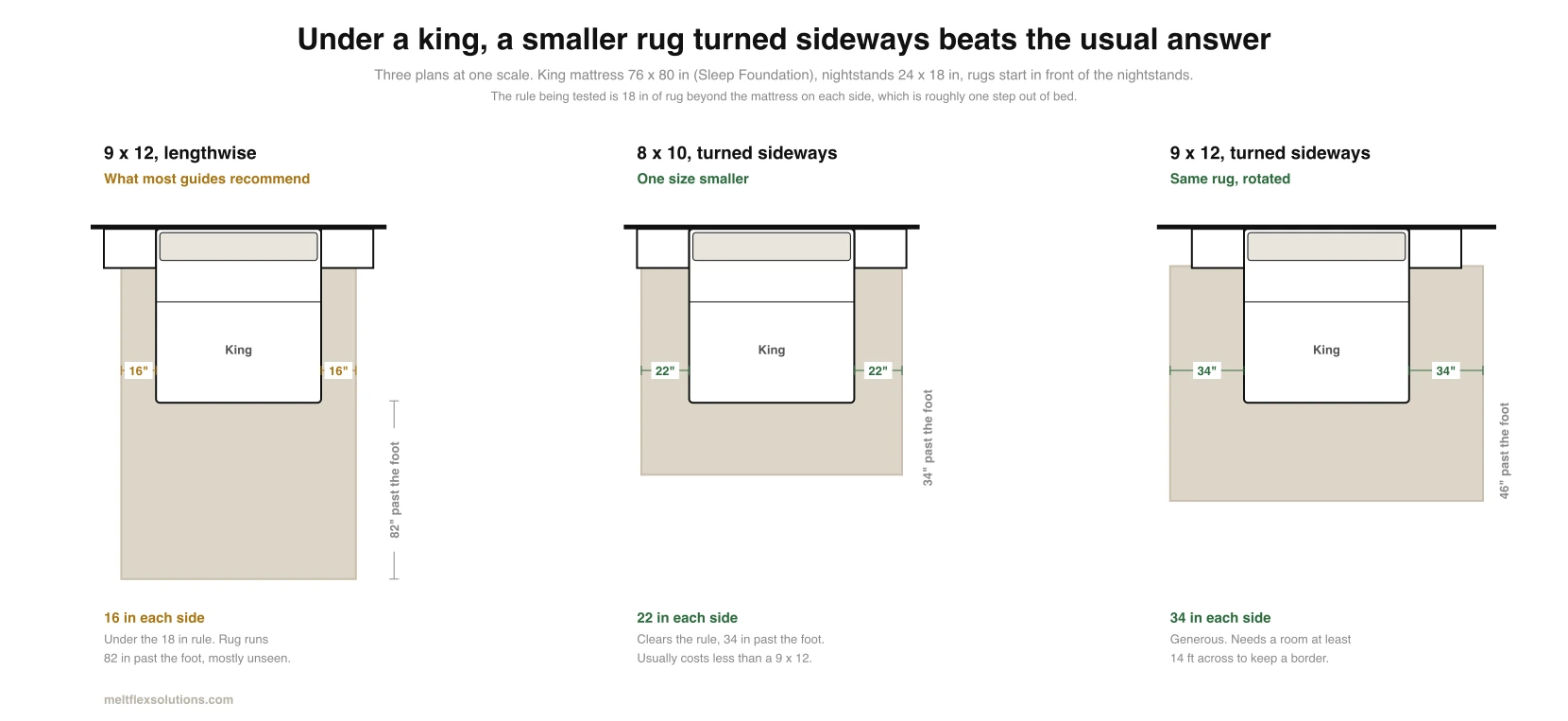
The middle panel is the finding. One size smaller, turned 90 degrees, and there is more rug where you actually step.
Turn an 8 x 10 sideways so the 10 foot side runs along the headboard wall and it is 120 inches across. Under a 76 inch king that leaves 22 inches a side, and started in front of the nightstands it still reaches 34 inches past the foot. It is 80 square feet against the 9 x 12’s 108, so in any given rug line it is the cheaper size, and it does the job better.
That also answers the 8 x 10 question people ask about kings. Laid lengthwise an 8 x 10 is 96 inches wide and leaves 10 inches a side, which looks too small and is. The rug was fine; the orientation was wrong.
If the room is about 14 feet across, a 9 x 12 turned sideways leaves 34 inches a side and is the generous version. Laid lengthwise, the rug a king actually needs is a 10 x 14 (22 inches a side). One more number worth knowing: a king plus two 24 inch nightstands is 124 inches wide, so not even a 10 x 14 can carry the whole group. If you want everything on the rug with a king, you need a 12 x 15 or nightstands of 22 inches or less.
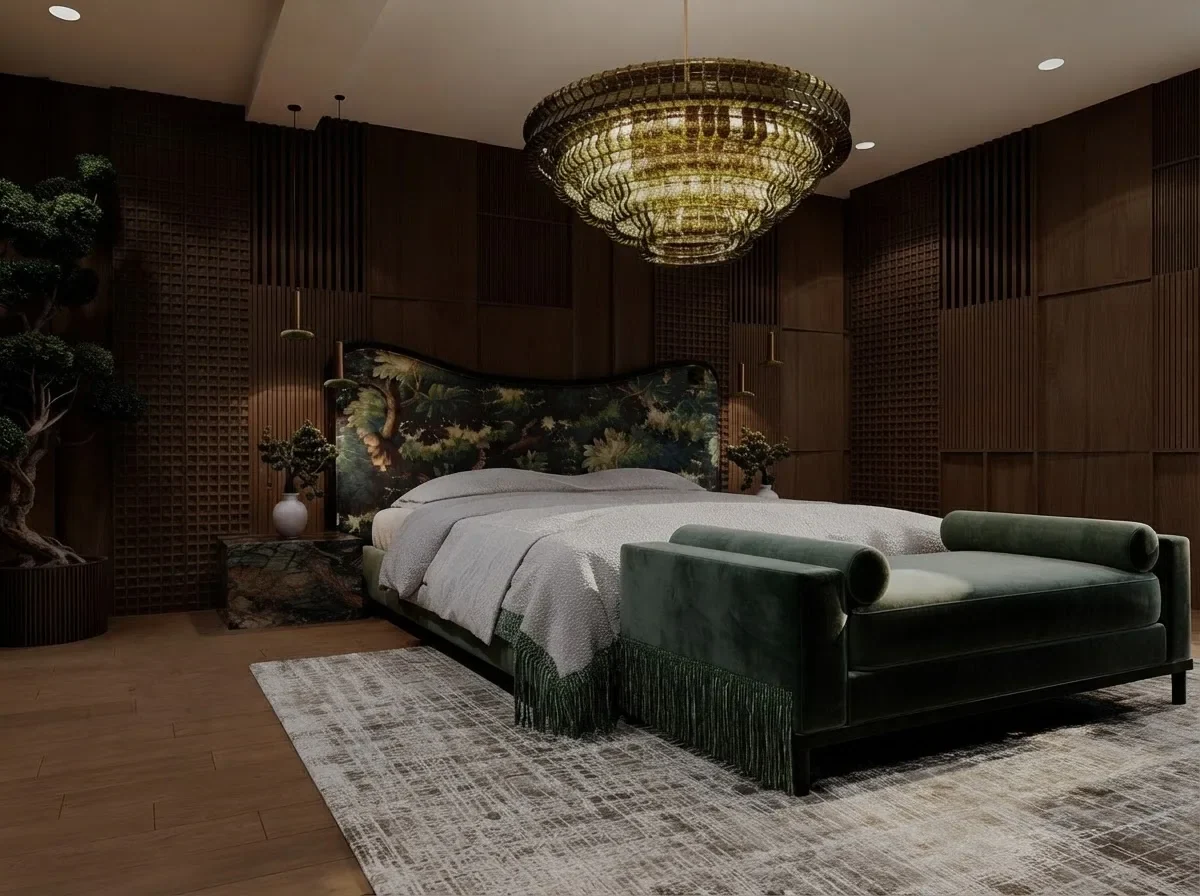
With a bench at the foot of a king, the rug has to reach past the bench too, or the bench sits half on and rocks.
Four ways to place a rug under a bed
Size and placement are one decision, not two. Pick the placement first and the size follows. Here are the four that work, all with the same queen bed.
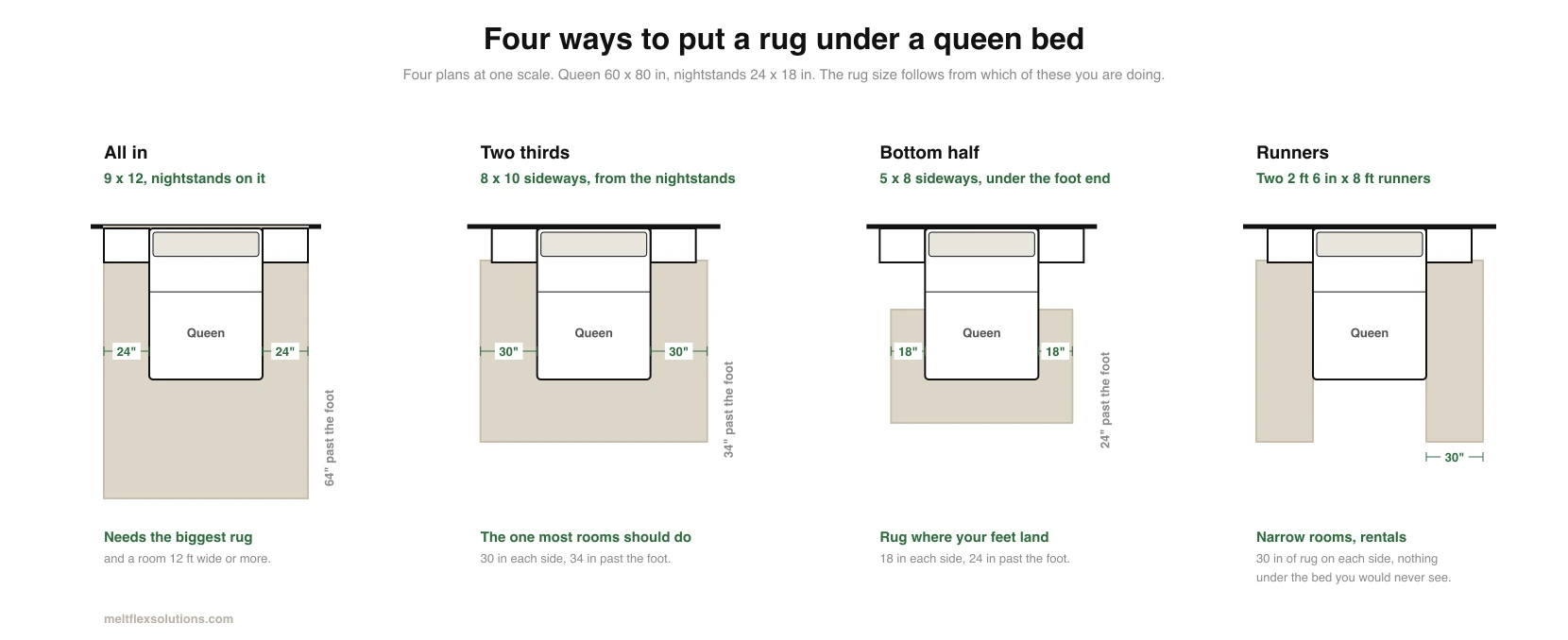
Four placements, one bed. All four clear the 18 inch rule. They differ in rug size, cost and how much room they need.
| Placement | Queen | King | Best for |
|---|---|---|---|
| All in, nightstands on the rug | 9 x 12 | 12 x 15 | Large primary bedrooms |
| Two thirds, starts in front of the nightstands | 8 x 10, either way | 8 x 10 or 9 x 12 sideways | Most bedrooms |
| Bottom half, sideways under the foot end | 5 x 8 or 6 x 9 | 8 x 10 | Smaller budgets, guest rooms |
| Runners, one each side | Two 2′6″ x 8′ | Two 2′6″ x 8′ | Narrow rooms, rentals |
Two thirds is the one to default to. Starting the rug just in front of the nightstands keeps them level on the bare floor, and the rug lands where you step out of bed. The rug does not disappear under the mattress for most of its area, which is where the money goes with an all in rug you mostly cannot see.
All in looks the most finished and suits a large primary bedroom, where the rug also has room to carry a bench at the foot.
Runners are underrated. Two 2 foot 6 inch runners give you 30 inches of rug each side of the bed, as much as an 8 x 10 turned sideways, for a fraction of the price. In a narrow room or a rental they are often the better answer, not the compromise.
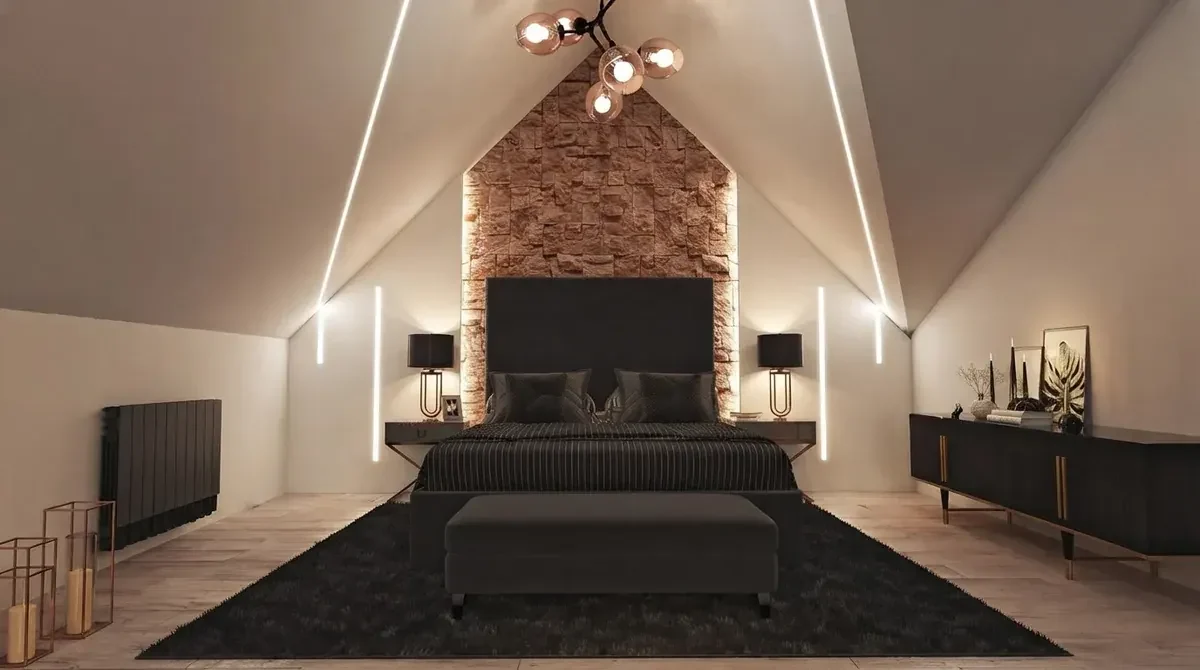
All in: bed, nightstands and bench all on one rug. It needs the largest rug and the widest room. Rendered in MeltFlex.
Your room decides the ceiling
The bed tells you the smallest rug that works. The room tells you the largest. Designers work to 12 to 18 inches of bare floor between the rug and the walls, and the wall that matters is the headboard wall, because that is the direction a sideways rug runs. Measure that wall first, from wall to wall, not from the bed.
| Headboard wall | Largest rug across it | Queen | King |
|---|---|---|---|
| 10 ft | 8 ft | 8 x 10 lengthwise or 5 x 8 sideways (18 in) | Runners. A king leaves 22 in to walk past each side |
| 11 ft | 9 ft | 6 x 9 sideways or 9 x 12 lengthwise (24 in) | 9 x 12 lengthwise (16 in) |
| 12 to 13 ft | 10 ft | 8 x 10 sideways (30 in) | 8 x 10 sideways (22 in) |
| 14 ft and up | 12 ft | 9 x 12 sideways (42 in) | 9 x 12 sideways (34 in) |
The depth of the room rarely limits a sideways rug, because it only has to reach about 9.5 to 10.5 feet from the headboard wall. A lengthwise 9 x 12 started at the nightstands needs 13.5 feet. That is one more reason sideways tends to win in real bedrooms, which are usually closer to square than the long rooms rug photos are shot in.
If the rug calculation keeps failing, the bed itself may be in the wrong place. A bed on a different wall, or in front of a window, changes which wall counts as the headboard wall, and with it the largest rug the room can take.
Full, twin, Cal king and two twins
Full (54 x 75 in). A 5 x 8 turned sideways leaves 21 inches a side and a 6 x 9 turned sideways leaves 27. An 8 x 10 lengthwise also works at 21 inches a side. A full is common in guest rooms, where the bottom half placement with a 5 x 8 is usually all the room needs.
Twin (38 x 75 in). A 5 x 8 turned sideways leaves 29 inches a side, which is generous. In a small kid’s room a 4 x 6 turned sideways (17 inches a side) is fine. Laid lengthwise a 5 x 8 leaves 11 inches, which is why it looks undersized that way.
California king (72 x 84 in). It is 4 inches narrower and 4 inches longer than a king, so an 8 x 10 turned sideways leaves 24 inches a side and still clears the foot by 30. Lengthwise, a 9 x 12 lands exactly on 18 inches, which is the one bed where that common recommendation is right.
Two twin beds. Two twins with a 24 inch nightstand between them span 100 inches. One rug under both, turned sideways, is the clean answer: an 8 x 10 leaves 10 inches outside each bed, a 9 x 12 leaves 22, a 10 x 14 leaves 34. A 9 x 12 is the one to aim for.
Dorm beds. Dorm beds are Twin XL, 80 in long, and often only 36 in wide rather than the retail 38. In a mirrored dorm layout in a 12 ft wide double they sit about 5 ft 8 in apart, so one rug between them works better than one under them. Our AI dorm room design guide has the mattress sizes 15 schools publish and the layouts that fit 49 real doubles.

Two twins, one rug. It joins the beds into one arrangement instead of two islands. Rendered in MeltFlex.
The rug under bed rules worth keeping
Most of what passes for rug rules is taste. These are the ones with a physical reason behind them.
- 18 inches of rug beside the mattress, 12 at the very least. It is the width of one step. Below 12 inches, one foot lands on rug and the other on floor.
- Nightstands all on or all off. A rug is a quarter to half an inch thick. With two legs on and two off, a nightstand tilts and the lamp on it wobbles. Either start the rug in front of them or make it big enough to carry them.
- At least 18 inches past the foot of the bed. Less than that and the rug looks like it has slipped. With a bench at the foot, the rug has to clear the bench.
- 12 to 18 inches of bare floor to the walls. A rug that touches the skirting looks like wall to wall carpet that shrank.
- Measure the frame, not just the mattress. Upholstered and platform frames are often several inches wider than the mattress, and the rug showing each side is measured from the frame, because that is what you see. Check the listing for the overall width.
- Use a rug pad. The bed holds the top of the rug, but the part you step onto is exactly the part that slides. If the bedroom has carpet, use a pad made for rug on carpet; a pad for hard floors will not stop it creeping.
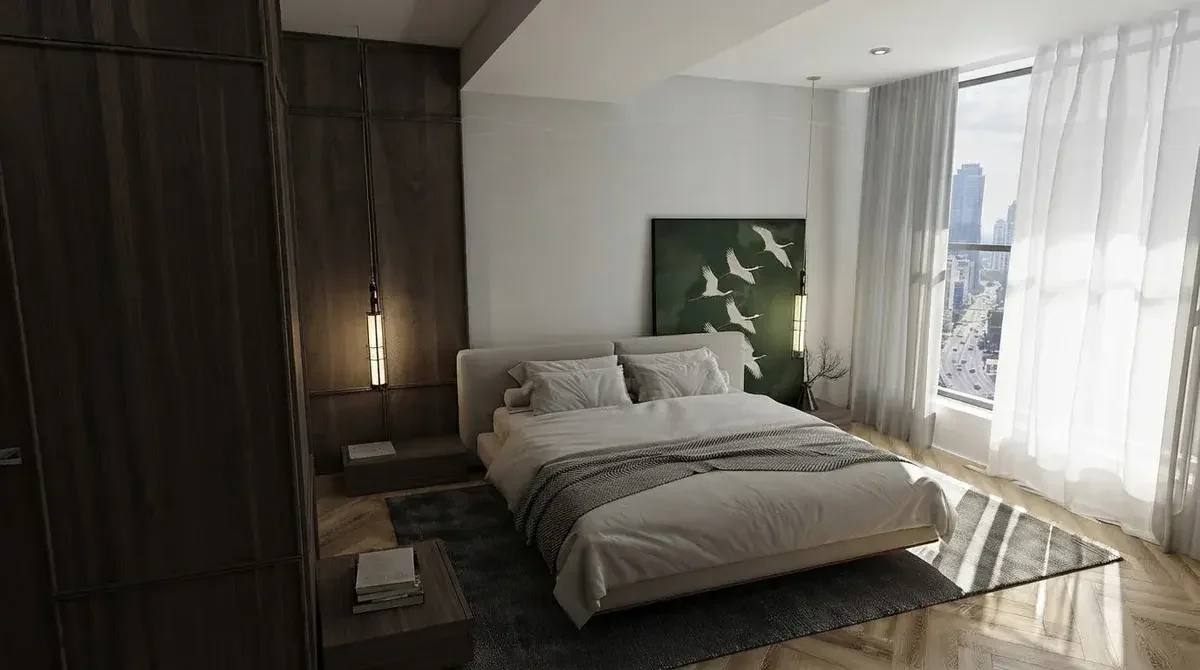
The test of any bedroom rug is the side view: is there rug where a foot would land?
Checking it before you buy
The numbers above settle the size. They do not settle whether a dark rug will make a small bedroom feel smaller, or whether a pattern fights the bedding. Two cheap checks cover both.
For size, mark the rug out on the floor with painter’s tape and sleep with it for a night. Getting out of bed onto tape tells you more than any chart. For color and pattern, a render of your own room is the quickest check: tools such as MeltFlex AI put different rugs into a photo of your bedroom, against your own floor and bedding. The video below shows the idea in a living room.
Use a render to judge color and pattern. Use tape on the floor to judge size, because a render is not a measuring tool.
Frequently asked questions
What size rug for a queen bed?
An 8 x 10. A queen mattress is 60 by 80 inches, so an 8 x 10 laid lengthwise leaves exactly 18 inches of rug on each side, which is about one step out of bed. Turn the same 8 x 10 sideways, with the 10 foot side running along the headboard wall, and you get 30 inches a side instead. If the room is 12 feet wide or more, a 9 x 12 placed against the wall is the upgrade: a queen plus two 24 inch nightstands is 108 inches wide, exactly the width of the rug, so everything stands on it.
What size rug for a king bed?
An 8 x 10 turned sideways, or a 9 x 12 turned sideways if the room is about 14 feet across. A king is 76 inches wide. The 9 x 12 laid lengthwise that most guides recommend leaves 16 inches a side, under the 18 inch rule. The smaller 8 x 10 turned so its 10 foot side runs along the headboard wall leaves 22 inches a side and still reaches 34 inches past the foot. Laid lengthwise, the size a king needs is a 10 x 14.
Is an 8x10 rug too big for a queen bed?
No. It is the standard size for a queen, and lengthwise it leaves exactly the 18 inches a side that most designers aim for. It only becomes too big when the room is too small for it: you want 12 to 18 inches of bare floor between the rug and the walls, so an 8 x 10 lengthwise needs a room at least 10 feet wide, and turned sideways at least 12 feet wide.
Will a 6x9 rug work under a queen bed?
Only turned sideways. Laid lengthwise a 6 x 9 is 72 inches wide against a 60 inch mattress, which leaves 6 inches a side, effectively nothing. Turned so the 9 foot side runs along the headboard wall and started just in front of the nightstands, it leaves 24 inches a side and ends 10 inches past the foot of the bed. That makes it a good size for a small bedroom.
Is a 5x7 rug too small for a queen bed?
Yes, as the main rug. Lengthwise it is 60 inches wide, exactly the width of the mattress, so no rug shows beside the bed at all. Turned sideways it leaves 12 inches a side and stops short of the foot. If your budget is a 5 x 8 or 5 x 7 size, a 5 x 8 turned sideways under the lower half of the bed does far better, with 18 inches a side, or put two runners down the sides instead.
Will an 8x10 rug work under a king bed?
Yes, turned sideways. With the 10 foot side along the headboard wall it is 120 inches across against a 76 inch king, which leaves 22 inches a side. Laid lengthwise it is only 96 inches wide and leaves 10 inches a side, which is why people who try it that way conclude it is too small.
Where should a rug go under a bed?
Most rooms should start the rug just in front of the nightstands and run it past the foot of the bed, so it covers the lower two thirds of the bed. That keeps the nightstands level on the bare floor and puts the rug where your feet land. The alternatives are a rug large enough for the nightstands to stand on it completely, a smaller rug turned sideways under the lower half of the bed, or two runners down the sides.
What size rug for a full bed?
A 5 x 8 turned sideways or a 6 x 9 turned sideways. A full mattress is 54 by 75 inches, so a 5 x 8 turned sideways leaves 21 inches a side and a 6 x 9 turned sideways leaves 27. An 8 x 10 laid lengthwise also works, at 21 inches a side, if the room is 10 feet wide or more.
Sources
- Sleep Foundation, Mattress Sizes and Dimensions, for all mattress dimensions.
- Ruggable, Rug Sizes guide, for the stocked rug sizes and runner widths.
- Search demand figures are Ahrefs US estimates, read 7 November 2026.
- All drawings in this article were plotted from those dimensions by MeltFlex. All photographs are MeltFlex renders.
How we made this guide
Every number here is arithmetic on published dimensions: mattress sizes from the Sleep Foundation and stocked rug sizes from Ruggable, with nightstands taken as 24 by 18 inches. We drew each combination to scale and read the clearances off the drawing. We did not lay these rugs in real bedrooms; the photographs are MeltFlex AI renders, chosen because the rug and the bed are both visible, not photographs of real rooms.
Disclosure: MeltFlex s.r.o., which publishes this blog, makes MeltFlex AI, shown in the sidebar and in the video. No rug brand paid to be mentioned.
Planning a bedroom for a client, a rental or a listing and want the visuals done for you? Book a free call.
More articles
Share article