AI Gallery Walls: Why the Art Always Hangs Too High

Almost every home has one wall that has been empty for two years. Not because nobody wants art on it, but because hanging things is irreversible in a way that buying a cushion is not, and the layout question ("how many, how big, how arranged") is genuinely hard to picture in your head.
This is a very good use of a render. Arrangement is shape and proportion, and shape and proportion are what image models handle best. The trouble starts the moment you try to take a measurement out of the picture, because the render put that art where it looked balanced inside a rectangular photo, and your wall is not a rectangular photo. It has a sofa in front of it and a person standing next to it.
A dense cluster works because the gaps are consistent and the whole block sits at one deliberate height. Both of those are numbers, not vibes.
The three numbers that do all the work
145 cm to the centre. Galleries and museums hang so that the centre of a work sits somewhere around 145 to 150 cm from the floor, because that is roughly average eye level for a standing adult. In a home this one rule fixes most bad walls. It applies to a single picture, and it applies to a group treated as one big rectangle: find the centre of the whole arrangement and put that at 145 cm. If your ceilings are unusually high, resist the pull to raise everything. The art relates to the people in the room, not to the cornice.
15 to 25 cm above the furniture. Over a sofa, a console or a bed, the bottom edge of the art wants to sit close enough that the two read as one composition. Much more than 25 cm and the picture detaches and floats. Much less and it looks like it slipped. This is also the number that overrides the first one: if 145 cm to the centre would leave a gap of 40 cm above a low sofa, go with the furniture.
5 to 8 cm between frames. Consistency matters far more than the exact figure. Pick a gap, use it everywhere, and keep the outer edges of the group aligned so the block has a clean silhouette. Uneven gaps are what makes a real gallery wall look accidental, and they are precisely what a render produces, because it has no reason to prefer one gap over another.
There is a fourth number that only bites once you are holding a drill. A hanging wire pulls up 5 to 10 cm when it takes the weight of the frame, so the hook goes that far below the top edge, not level with it. Measure the frame, hang the wire taut with a finger, measure again. This is where most crooked, too-high pictures actually come from.

A salon hang breaks the grid on purpose, and it still obeys the rules: a consistent gap, an aligned outer edge, and the mass of the group centred on an eye line.
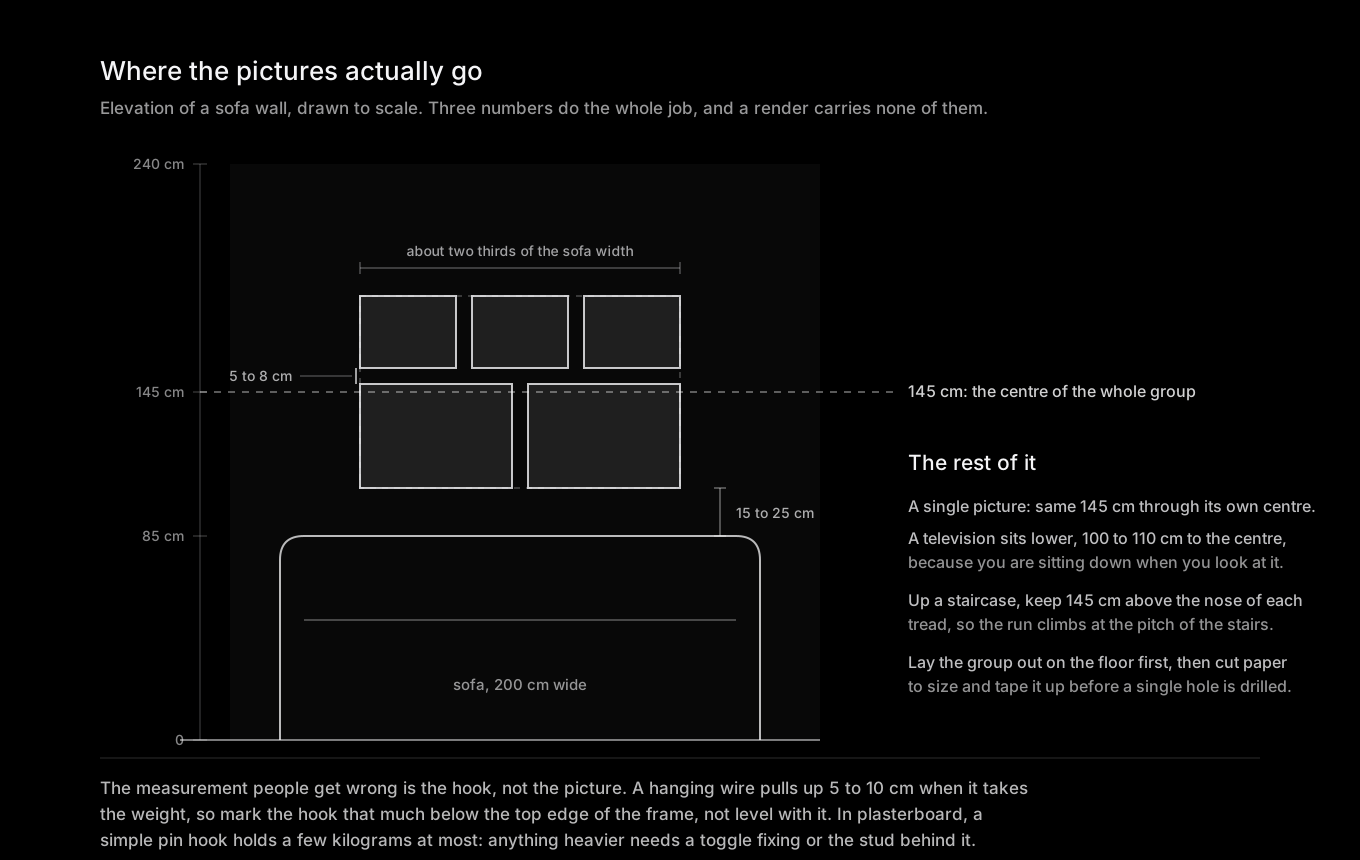
Everything above, drawn to scale on a 240 cm wall. The measurements are simple. The reason renders miss them is that a picture has no floor.
Where AI actually helps
Choosing between arrangements. One big piece, a tidy grid of six, an asymmetric cluster, or a long horizontal run. Seeing your own wall four ways settles this in minutes and it is the decision that keeps walls empty for years.
Scale relative to your sofa. As a working rule the art, or the group, wants to be about two thirds of the width of the furniture below it. Renders convey that relationship well because it is pure proportion, and it is the most common real-world mistake: a modest frame stranded above a three-seater.
Frame finish against your wall colour. Black, oak, brass or white read completely differently against a pale wall and a dark one, and this is a colour judgement in your own light, which is the thing photo-based restyling is genuinely good at. If the wall itself is still up for debate, run the two decisions together with an AI paint colour visualiser, since frame colour and wall colour only make sense as a pair.
Density. How much wall to leave breathing. A render will tell you honestly whether nine frames is generous or oppressive in your particular room.
The paper template method in that video is the physical version of what a render is doing on screen, and it is worth doing both. The render narrows the arrangement down. The paper tells you whether it fits between the light switch and the corner.
The failure modes, so you can spot them
Art hung at picture-rail height. The signature tell. Models compose within the image, and a composition usually looks calmer with the art nearer the middle of the frame, which puts it far above 145 cm on a real wall. If the render's art sits above the top of a door, it is too high.
Oversized canvases. A render will happily put a two metre canvas over a 1.8 metre sofa, partly because oversized art photographs well and the training data is full of it. Check the width against the furniture rather than against the wall.
Gaps that drift. Measure the spacing between frames in the image, roughly, with your fingers on the screen. If it varies from pair to pair, the layout in front of you is not a layout, and copying it will produce exactly the accidental look you were trying to avoid.
Hardware that does not exist. Frames sitting flat with no visible fixing, wires floating, a heavy mirror with nothing holding it. The top edge of any hung object is where models have the least training signal and the most freedom, the same weakness that produces impossible curtain headings in AI interior design for curtains.
Mirrors that lie. If the arrangement includes a mirror, whatever it reflects in the render is invented. That is a whole failure mode of its own, covered in why AI gets bathroom mirror reflections wrong.
Invented artwork. Obvious, but worth stating: the images inside the frames are not products. Use them as placeholders for tone and contrast, nothing more.
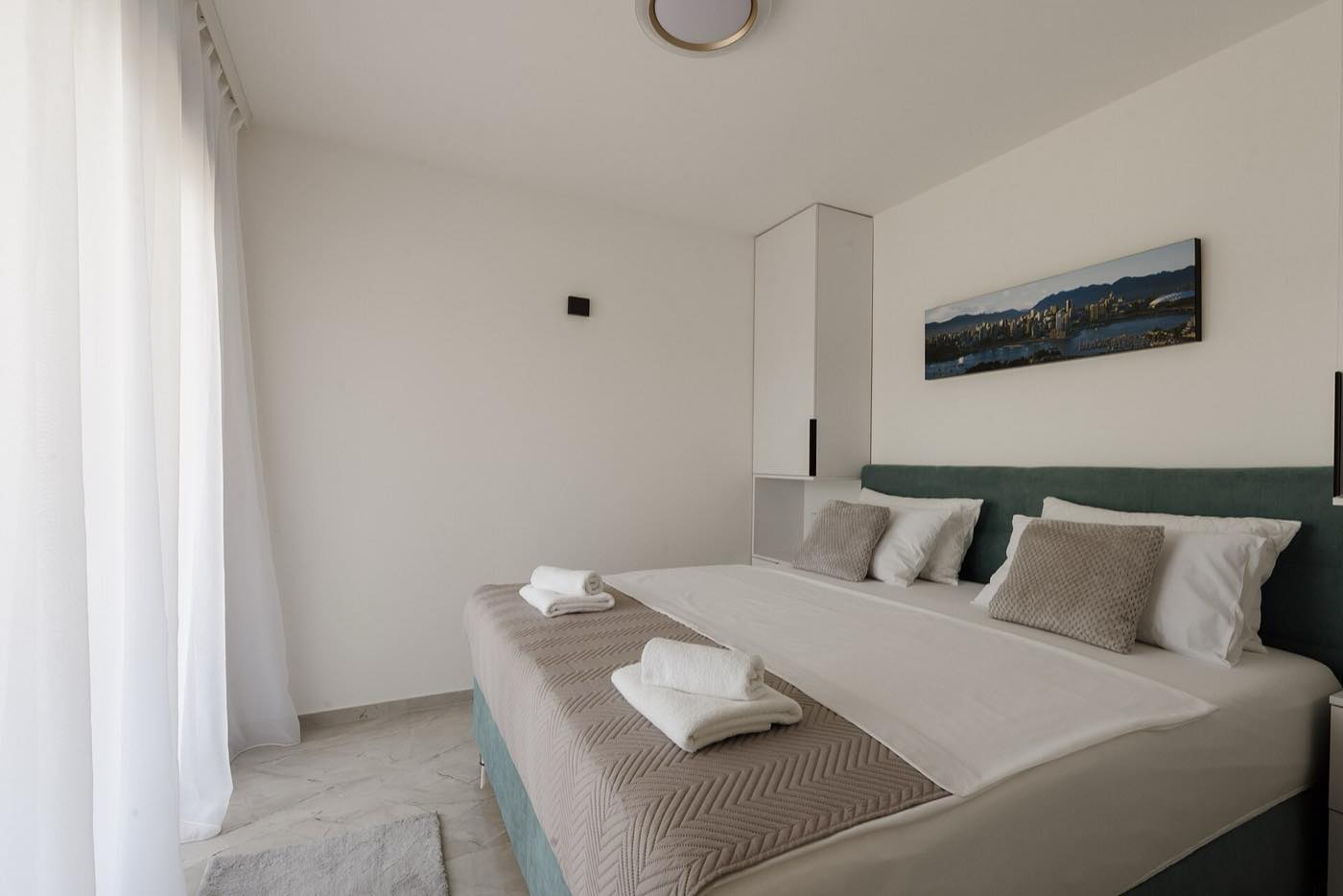
One piece, correctly proportioned to the bed below it, does more than six pieces hung at random heights.
A render answers "does this arrangement suit this wall". It does not answer "where does the hook go". The first question is the creative one and the second is the one that leaves holes.
How to get from render to wall without regret
Photograph the wall straight on from a couple of metres back, on the 1x lens, with the furniture in shot, because the furniture is what the art has to relate to. Restyle only the wall art and keep everything else constant, so you are comparing arrangements rather than comparing rooms. Reject any output where the sofa moved or the ceiling grew, because a model that rebuilt the room has not told you anything about your own.
Then get the layout off the screen. Lay the frames out on the floor first, shuffle until the gaps look even, and cut paper rectangles the size of each frame. Tape the paper up, live with it for an evening, and check it from the doorway and from where you actually sit, because a gallery wall is mostly seen from a sofa, not from a metre away.
Mark the hook positions on the paper before you take it down. That way the drill goes through the template, the height you decided is the height you get, and the wall ends up with the number of holes you intended.
One last practical note that no render will raise: plasterboard. A simple pin hook holds a few kilograms at most, and anything heavier needs a toggle fixing or the timber stud behind the board. Heavy mirrors and large framed glass are the pieces that come down at three in the morning.
Questions people ask about AI and wall art
Can AI tell me how high to hang my pictures?
No. There is no floor plane and no scale in an image model, so the height in a render is a composition decision, not a measurement. Use 145 cm to the centre of the piece or the group, adjusted so the bottom edge stays 15 to 25 cm above whatever furniture sits below. The short version is in our answer on whether AI can tell you how high to hang your pictures.
How do I hang a gallery wall up a staircase?
Follow the pitch of the stairs rather than levelling everything. Keep the centre of each piece about 145 cm above the nose of the tread directly beneath it, so the run climbs at the same angle as the staircase. Renders straighten staircase hangs into a horizontal row, which is the same instinct that makes them straighten a sloped ceiling.
What about renting, where I cannot drill?
Adhesive strips are rated by weight and are genuinely fine for light frames, particularly with acrylic glazing instead of glass, but they fail in damp rooms and they do lift paint on their way off. Picture rails and leaning shelves are the other honest options. We go through the deposit-safe version of this in AI interior design for renters.
Should the frames match?
They do not need to, but the group needs one thing in common: all the same frame colour, or all the same mount, or all black and white images inside mixed frames. Renders happily mix five finishes at once because it photographs as eclectic, and in a real room the same mix usually reads as a pile of things that arrived separately.
The honest position: gallery walls are a design problem with an arithmetic tail, and AI handles the design half well. Let it choose the arrangement, the density and the frame finish in your own room, which is the part that keeps a wall blank for years. Then take the three numbers, cut some paper, and hang the thing at eye level like a gallery would. If the floor is next on your list, the same split shows up again in AI interior design for rugs.
Image credits: "Man packing luggage in a stylish hotel room with framed photographs on wall", "Man reading magazine in living room with wall art" and "Cozy bedroom with two beds window and wall art in a simple setting" by Shixart1985, licensed CC BY 2.0, via Wikimedia Commons. Diagram by MeltFlex Solutions.