AI Interior Design for Curtains: What the Renders Get Wrong
Curtains are the cheapest large change you can make to a room and the easiest one to get wrong. A sofa that is slightly the wrong colour is a sofa. Curtains that are the wrong length read as a mistake from the doorway, every day, forever, and you cannot fix them without buying the fabric again.
So this is exactly the decision you want to preview. The problem is that a curtain is two different things at once. It is a colour and a texture, which AI handles well, and it is four measurements, which AI does not handle at all.
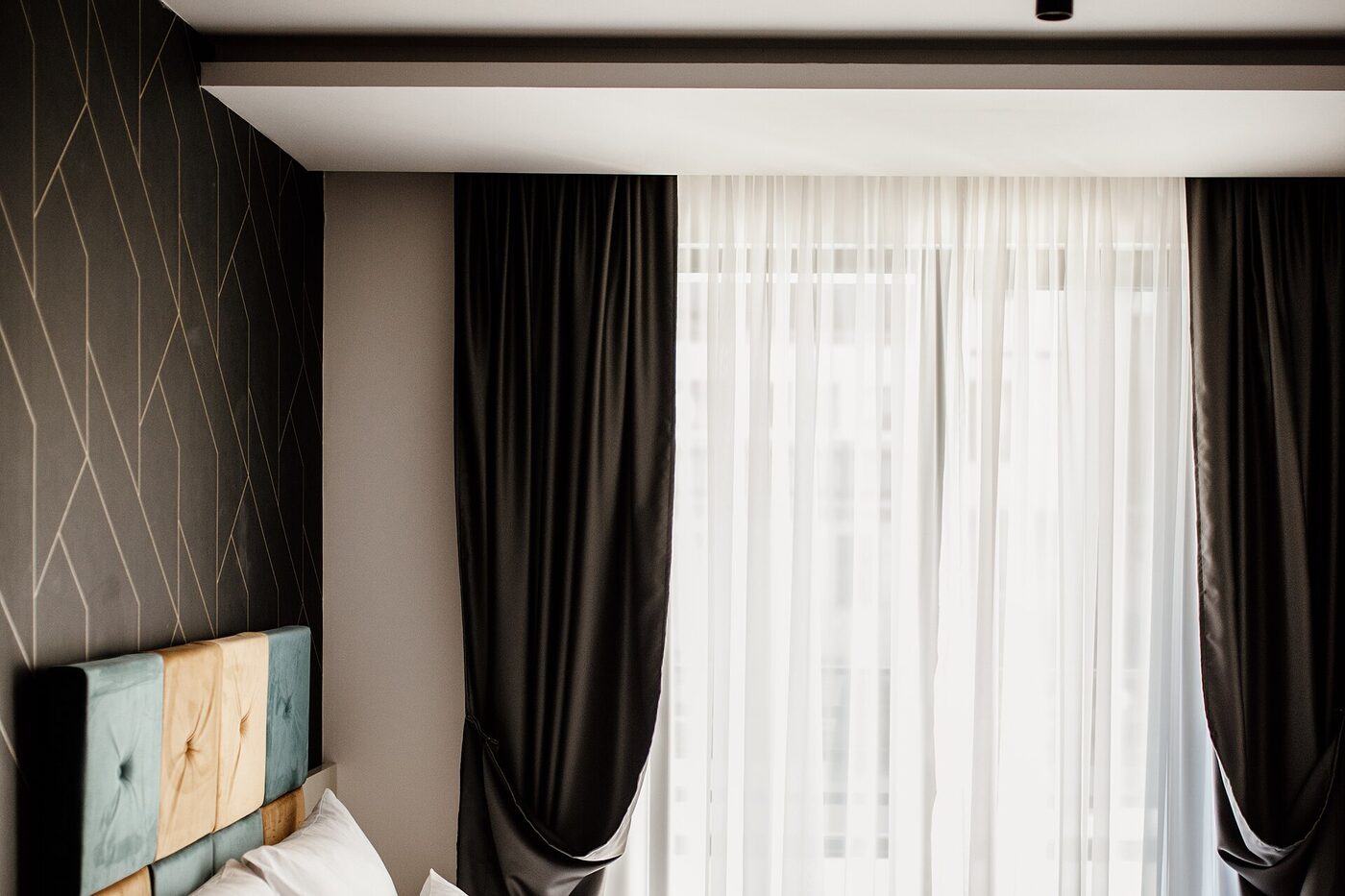
Two layers, ceiling-mounted, floor-length. Everything that makes this work is a number the render does not carry.
The four numbers a render never carries
Drop. There are four legitimate places a curtain can end, and they are not interchangeable. At the sill. About 10 to 15 cm below the sill, on the apron. Just clearing the floor by a centimetre or two. Or long enough to break or puddle. A render will land the hem wherever the composition looks calm, which in practice means a random height that belongs to none of these. If your render shows a hem floating five centimetres above a floor, that is not a design choice, it is the model failing to commit.
Fullness. Curtains look like curtains because there is roughly twice as much fabric as the space they cover. The trade convention is a fullness of 2 to 2.5 times the track width for a proper gathered look, less for a flat sheer, more for a heavy formal treatment. This is the single biggest tell of a cheap window: not the fabric, the fullness. AI renders fabric as a surface with painted-on folds rather than a real width of cloth, so it drifts toward flat, and a flat curtain reads as a bedsheet no matter how expensive the linen.
Stack-back. When the curtains are open, the fabric has to go somewhere, and that somewhere is the wall each side of the window. As a working figure, an open pair stacks into roughly a quarter to a third of the track width in total, split between the two sides, and more for a heavy interlined fabric. Get this wrong and your beautiful curtains permanently cover a slice of the glass, which is a real problem in a room that was short of light in the first place. A render almost always shows curtains open and neatly pinned to the very edge of the reveal, taking up no space at all, because a picture is prettier that way.
Heading. Pinch pleat, goblet, pencil pleat, wave, eyelet, tab top. Each of these is a different product, hangs differently, needs different hardware, and costs differently. Models blur them. A very common render is a wave heading hanging from rings on a pole, which is not a thing you can buy: wave is a track system. If you take that image to a curtain maker they will politely ask what you actually want.
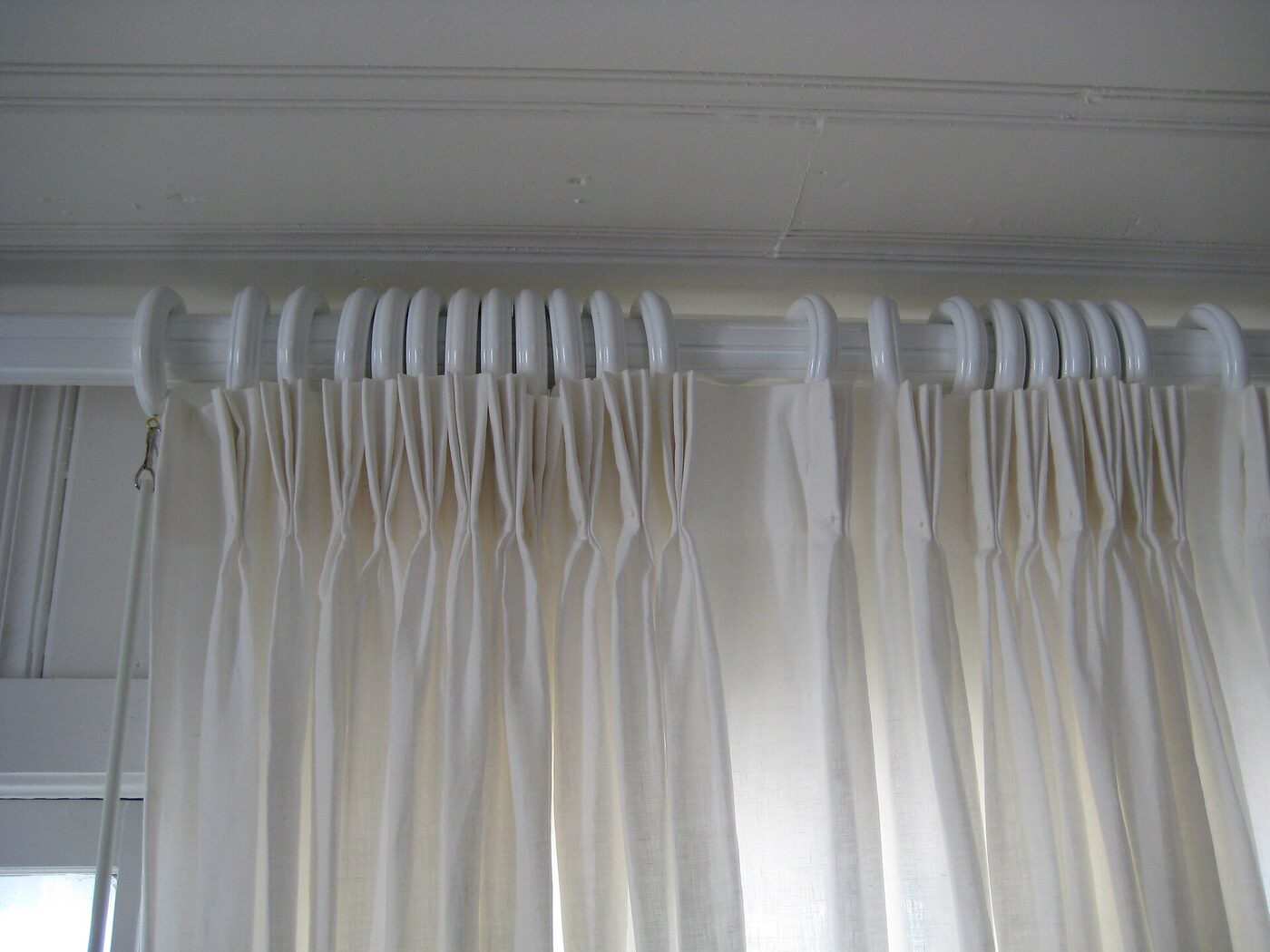
A pinch pleat on rings. The heading is a product decision, not a texture, and it is the detail AI most often invents.
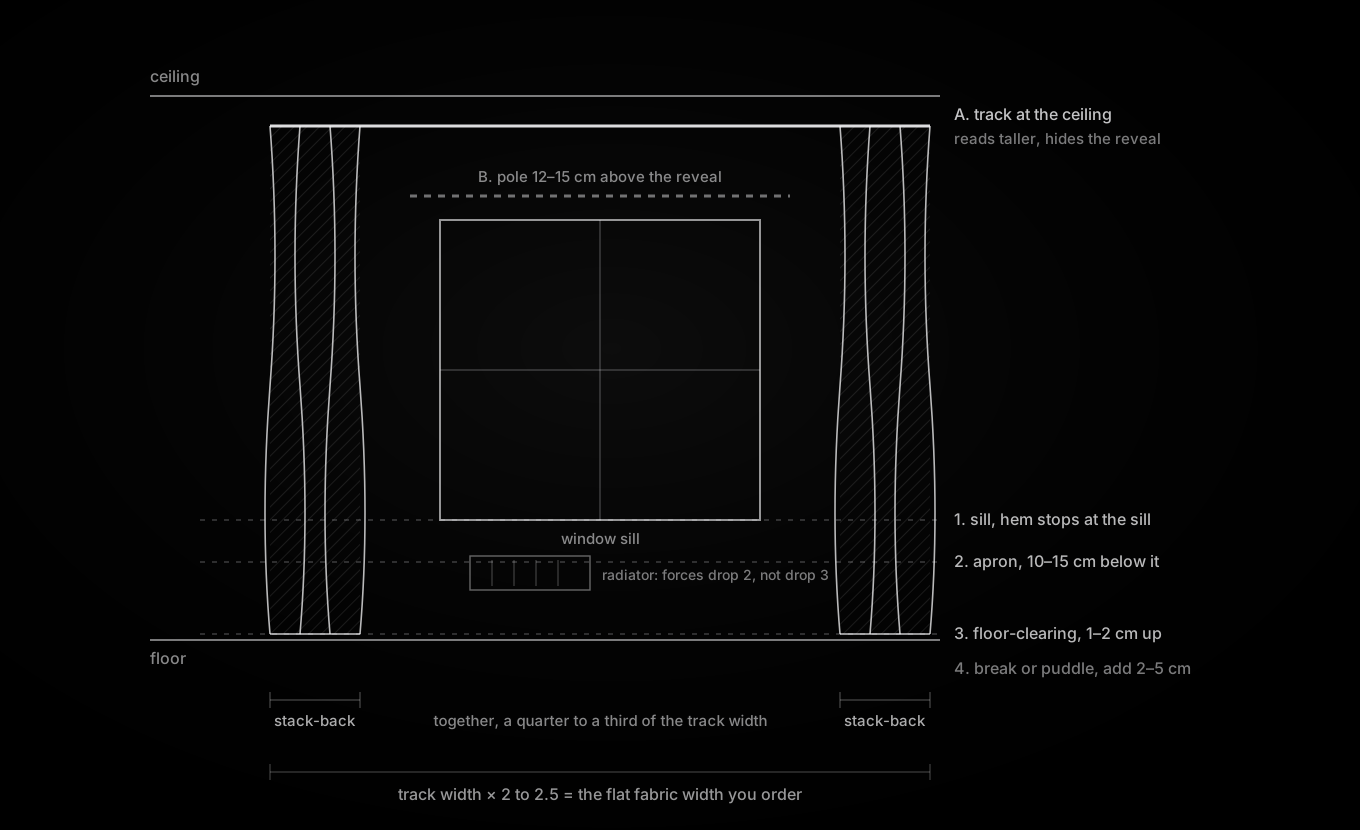
The four legitimate hems, the two places the track can go, and the wall space the fabric needs when it is open. A render carries none of this.
Where AI is genuinely worth the time
Once you have accepted that the numbers come from a tape measure, what is left is the part people actually agonise over, and it is the part AI does well.
Colour, in your light, against your wall. A curtain sample is a 15 cm square held up in a shop. It tells you almost nothing about how three metres of that colour will behave hanging next to your particular wall, in your particular light. A restyle of your own photo tells you a lot. This alone is worth the exercise, especially in a room where the curtains are the largest block of colour.
Weight and opacity. Seeing the same window as a sheer, as an unlined cotton, and as an interlined velvet is a genuine comparison, because the difference between them is mostly visual mass, which is exactly what a render is good at. Just do not trust it on how much light gets through. That is physics, and the model is not calculating any.
Hanging height, which is the free upgrade. The most reliable move in the whole subject is hanging the track at or near the ceiling rather than just above the window, because it makes the wall read as taller and the window as larger. It is also the move people are most nervous about, because it sounds wrong until you see it. Generate both versions of your own room and the argument ends in about four seconds.
Pattern scale. Whether a pattern is too big for your window is a proportion question and proportion is visible. Whether the pattern repeats correctly across the panels is not something to judge from a render, because models cannot hold a repeat.
The demo above is about a rug, not a curtain, but the mechanic is identical and it is the one that matters here: the same room, restyled repeatedly, so you compare one large textile against another in the space it will actually live in. That is the whole value proposition for curtains too.
The specific failure modes, so you can spot them
Sheers that transmit light wrongly. A sheer is defined by what happens to daylight passing through it. The model paints a bright rectangle that looks like a lit sheer rather than computing transmission, so you get windows that glow brighter than the sun outside, or heavy velvets that mysteriously let light through.
The radiator. In a great many homes there is a radiator under the window, and it silently rules out the floor-length option in favour of a sill or apron drop, because floor-length curtains over a radiator send your heating up behind the fabric and out of the glass. Renders put floor-length curtains over radiators constantly. It looks lovely and it is expensive in a way that shows up on a bill rather than in a photo.
Bay windows. A bay needs a bent track or three separate poles, corner joints, and a stacking plan for each section. Renders treat a bay as one flat window with a curtain photoshopped across it.
Invented hardware. Finials that are not on any pole, brackets floating with no fixing, a track that passes through a wall. Look at the top 20 cm of any curtain render with real suspicion, because that is where the model has the least training signal and the most freedom.
A curtain render answers "does this colour work here". It does not answer "will this fit". Those are two different questions and only one of them has a picture as the answer.
How to get a curtain render you can act on
Photograph the window straight on from a couple of metres back, with the 1x lens rather than the ultra-wide, because a wide lens bows the wall and shifts the apparent proportions of the whole window. Shoot in daylight with the existing curtains open, so the model has the full reveal to work with. Then restyle only the window treatment and hold everything else constant, so you are comparing fabrics rather than comparing rooms.
Reject any output where the window has changed size, the sill has moved, or the wall above the window has grown to make room for a taller curtain. Those are all the same failure: the model reverting to the generously proportioned window it saw a million times in training, rather than the one in your flat.
Then measure. Track width, the drop from where the track will go to where you want the hem, the wall available each side, and the radiator if there is one. Take those four numbers and the picture to whoever is making the curtains. The picture sells the idea. The numbers make it exist.
Questions people ask about AI and curtains
Can AI show me what curtains will look like in my actual room?
Yes, and this is its best use. A restyle of your own photo shows a real length of your chosen colour against your real wall in your real light, which a 15 cm shop sample cannot do. Treat the result as accurate about colour, fabric weight and hanging height, and as fiction about any measurement. Related reading: why AI renders your room brighter than it is.
Why do curtains in AI renders end at a strange height?
Because the model has no reason to prefer one hem height over another. Real curtains end in one of four places: at the sill, on the apron 10 to 15 cm below it, clearing the floor by a centimetre or two, or long enough to break. A render lands wherever the picture looks balanced, which is usually none of those. Pick the drop yourself, then ignore what the render did with it. The short version lives in our answer on why curtains in AI renders hang wrong.
Should I hang curtains at the ceiling or just above the window?
This is the one question a render answers better than any article, because it is purely a proportion judgement. Ceiling-mounted track makes the wall read taller and the window larger, and pole-above-reveal is more traditional and less work. Generate your own room both ways and the answer is usually obvious within seconds.
Can AI tell me how much fabric to order?
No. Fabric quantity comes from track width times a fullness of about 2 to 2.5, plus hems, plus pattern repeat allowance, and none of those exist inside an image model. Renders systematically show too little fullness, so if you copy what you see you will order a flat, disappointing curtain.
Curtains rarely get decided on their own, and the two things that usually move with them are the wall behind them and whatever hangs on it. Both split the same way between what a render sees and what it cannot measure: AI paint colour visualisers and AI gallery walls and art placement.
The honest position: curtains are half a colour decision and half an arithmetic problem, and AI is excellent at the first half and absent from the second. Use it to settle the colour, the weight and the height, which are the parts that keep people stuck for weeks. Then put the picture down, pick up a tape measure, and let the numbers do the rest.
Image credits: "Cozy hotel room with modern furnishings and natural light flowing through the curtains" by Shixart1985, licensed CC BY 2.0; "Hanky Linen Sheer Curtains with pleats and rings" by Posh Living, LLC, licensed CC BY-SA 2.0, via Wikimedia Commons. Diagram by MeltFlex Solutions.