How Much Does an Interior Designer Cost? 2026 US Rates
 Matúš Koleják
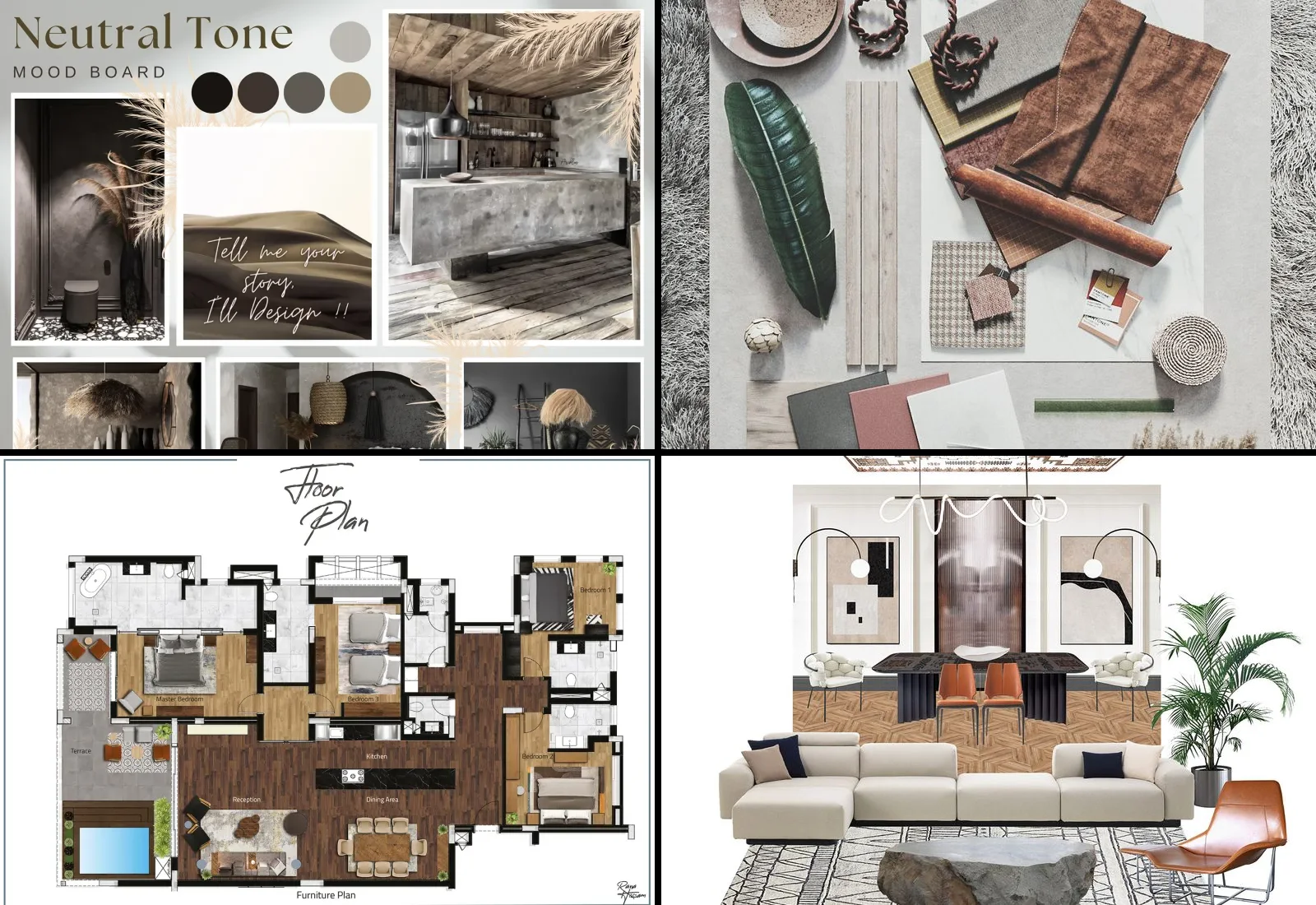
What a design fee actually pays for: mood boards, material boards, furniture plans and concept boards. Projects on Behance: Mood board, interior inspiration boards by Eugenio Ettore Alemanni, Mood Boards, Materials Boards by ulfat ktaifan, Mood Boards For A Residential Apartment by Rana Hossam and Interior Design Moodboard by Space L Design Studio.
Ask "how much does an interior designer cost" and most answers give you one national range, usually from a lead-generation site that earns money when you request quotes. The honest answer is that designers sell very different products under the same job title, from a two-hour color consultation to a two-year renovation, and the price of the design fee is often not the biggest number on the bill. So instead of quoting someone else's average, we opened the pricing pages of designers who actually publish their fees and put them side by side.
How much does an interior designer cost?
Here is what the 19 designers and 3 online services in our sample charge, grouped by the way they bill. Every number comes from the firm's own website.
| What you buy | Published price range | Examples from the sample |
|---|---|---|
| Hourly design time | $145 to $250 an hour | $225 in Atlanta and Seattle, $250 at a New York studio |
| First consultation | $200 to $700 | $200 for one hour near Houston, $700 for two hours in New York |
| Designer for a day (5 to 6 hours) | $1,049 to $2,400 | $1,049 in Minneapolis, $1,399 in St. Louis, $2,400 in New York |
| E-design, per room | $199 to $2,805 | Havenly $199 list price, Spacejoy $199 to $599, Decorilla $849 to $2,805 for a living room |
| Full service, per room (design fee) | from $3,500 to $5,000 | $3,500 in Tallahassee, $5,000 in New York |
| Per square foot | $15 to $21 per sq ft | one Dallas studio, for large renovations and new builds |
| Whole home (design fee) | from $25,000 to $100,000+ | two New York studios |
| Furniture minimum per room | $15,000 to $35,000 | Florida, Texas and New York firms |
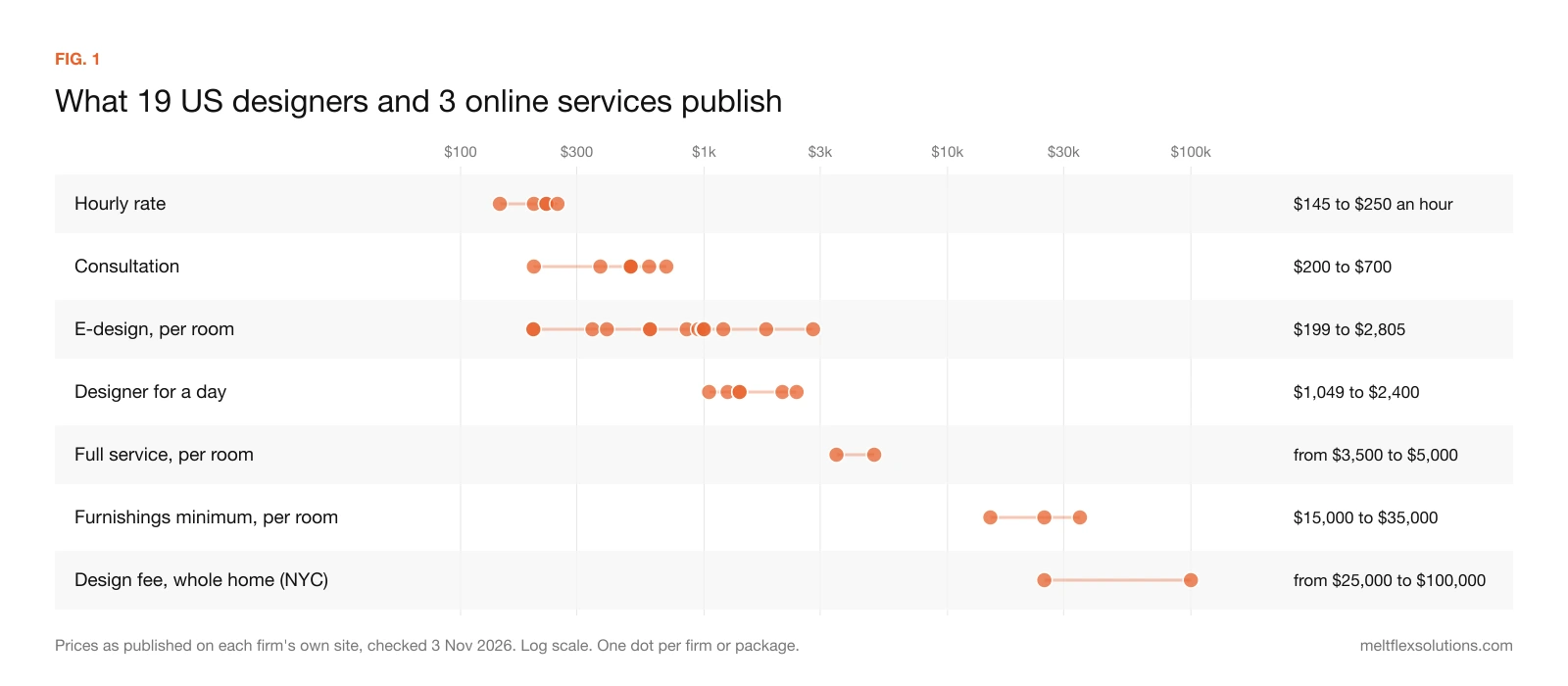
Two things stand out. The cheapest and the most expensive way to "hire an interior designer" differ by a factor of about 500. And the steps are not gradual: there is a wide gap between a $2,400 design day and a full-service project, because full service is priced around your furniture budget, not around the designer's hours.
How interior designers charge
Almost every designer uses one of six fee models, or a mix. Knowing which one you are being quoted matters more than the headline number, because the same project can cost very different amounts under each.
1. Hourly
You pay for the time the designer spends on your project: meetings, drawings, sourcing, ordering, site visits. In our sample the rates were $200 to $250 an hour, with one Los Angeles studio selling prepaid blocks that work out cheaper ($1,500 for 10 hours, $5,800 for 40 hours, so $145 an hour at the top). A New York studio bills creative direction at $250 an hour and administrative work at $125 an hour, which is a useful detail to ask about: a lot of design hours are spent tracking deliveries, not choosing sofas.
Hourly suits small or vague projects. Its weakness is obvious: you cannot see the final bill in advance. Ask for an estimate of hours per phase and a cap.
2. Consultation
A one-off visit, usually one or two hours, where the designer walks the space and gives advice you carry out yourself. Prices in the sample run from $200 (one hour, Houston area) to $500 (two hours in your home, Seattle) and $700 (two hours, New York). One New York firm credits its $499 consultation against the project if you hire them afterwards, which is worth asking for anywhere.
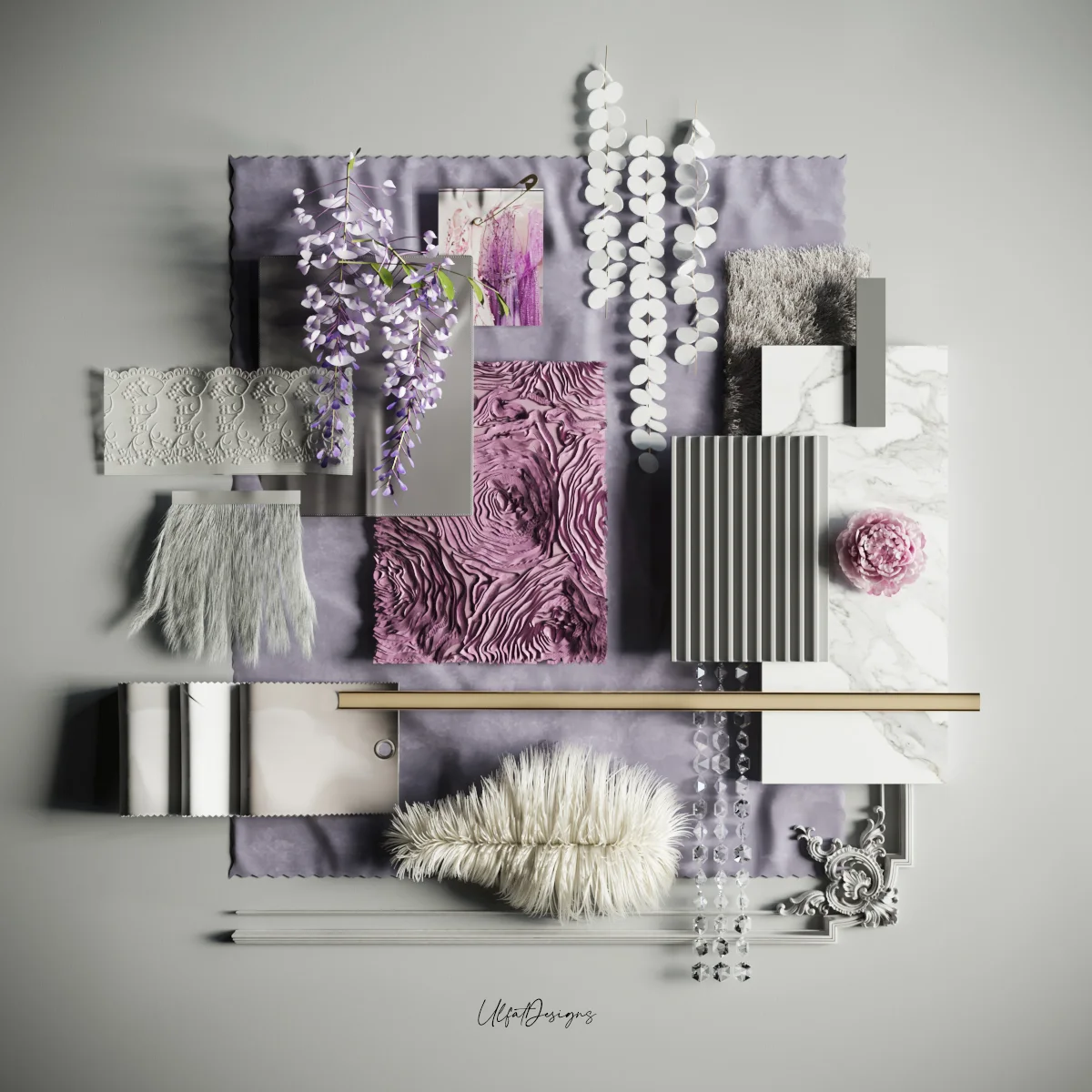
A material board, the kind of thing a consultation or a design day often ends with: real samples you can hold against your own walls and light. Project: Mood Boards, Materials Boards by ulfat ktaifan on Behance.
3. Designer for a day
A fixed block of five or six hours, often spent shopping together or making a plan for several rooms. This was the most common published offer in our sample, at $1,049 to $2,400. Paying for a day is usually cheaper per hour than paying hourly: a $1,399 six-hour day is $233 an hour, a $1,049 five-hour day is $210.
4. Flat fee per room or per project
The designer quotes one price for the design of a room or a whole home. Published examples: from $3,500 per room in Florida (with a required $15,000 furniture budget on top), from $5,000 per room and from $25,000 for a full home in New York. At the top, one New York studio lists design fees starting at $100,000 for furnishing a home, $140,000 with a renovation and $350,000 for a full-gut house or new build. These are fees for design only, before a single chair is bought.
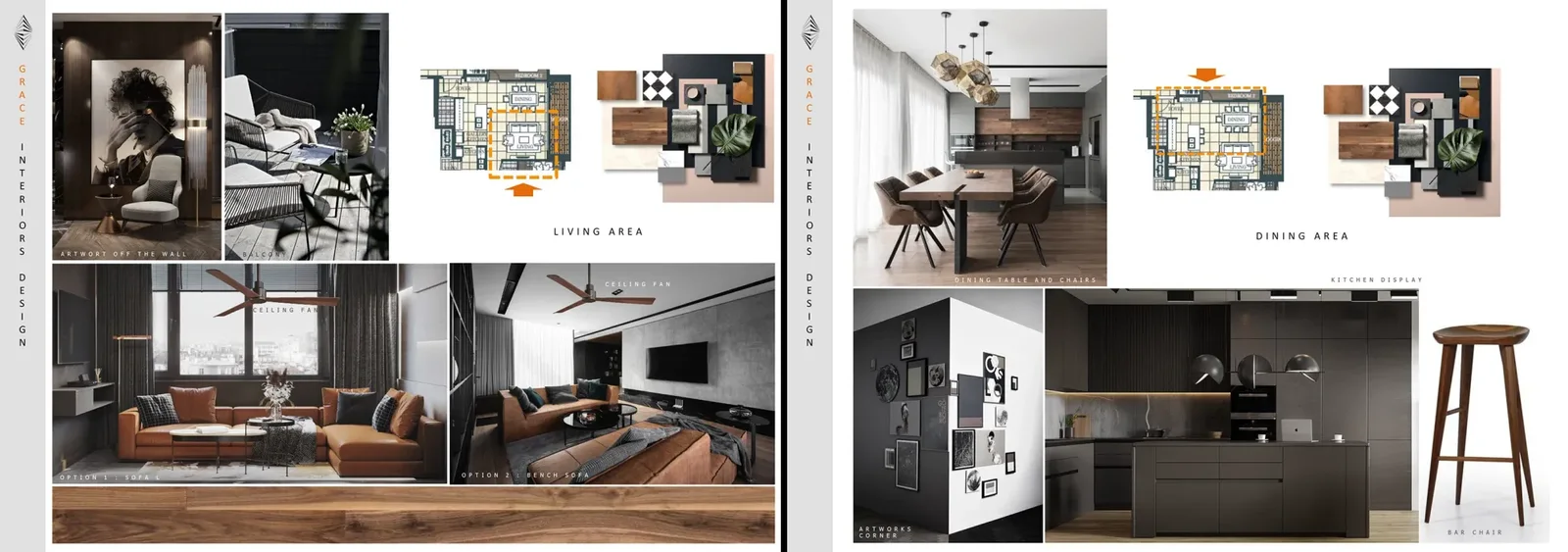
Per-room concept boards with a key plan, product options and the material palette: a typical deliverable of a flat-fee or full-service project. Project: Mood board 1 by Dimora Interiors on Behance.
5. Percentage of the budget or per square foot
Some designers charge a share of what you spend, or a rate per square foot. A San Antonio firm suggests setting aside 15 to 25% of your budget for design fees, and a Dallas studio says its fees for large renovations and new builds often fall at $15 to $21 per square foot. On a 3,000 sq ft new build that would be $45,000 to $63,000. None of the 19 firms published a pure "percentage of project" fee, although it still appears in many contracts.
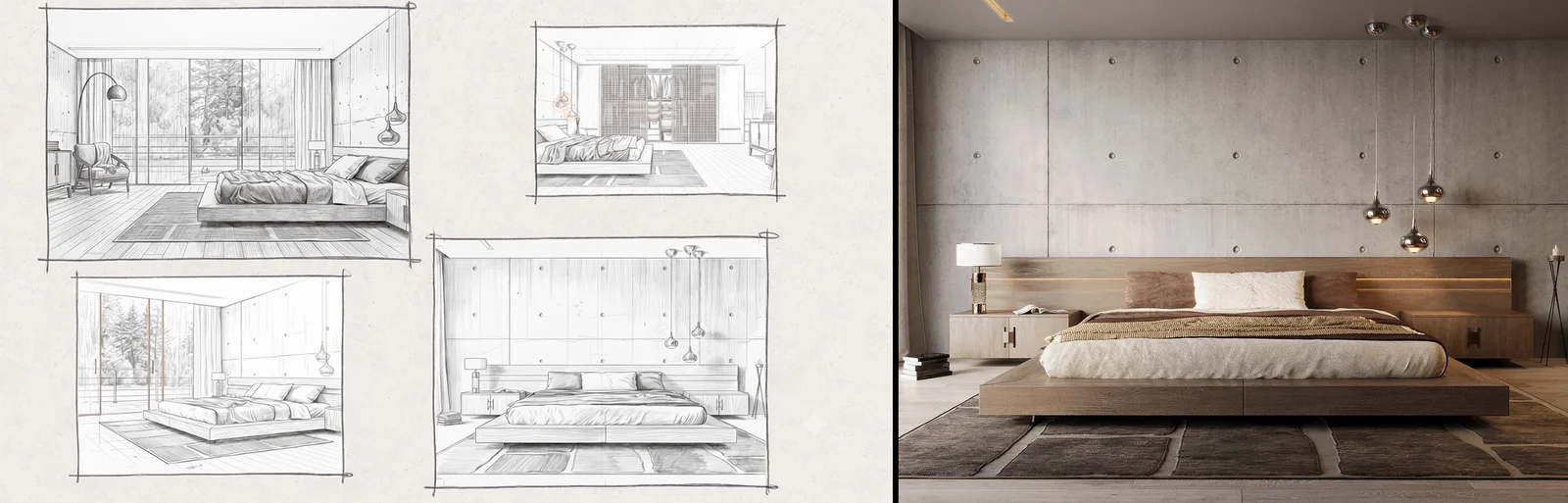
From sketches to a photorealistic render of one bedroom. Each round of drawings and revisions is time, and on hourly or percentage contracts it is billed, along with the software behind it (see what SketchUp costs). Project: Master Bedroom Interior Design, 3D Rendering by Tetiana Visual 3D on Behance.
6. Markup on furniture and materials
Designers buy from trade showrooms at a discount, and many make part of their income on the difference. This is where clients get surprised, because it rarely appears in the headline price. The policies we found differ a lot:
- An Austin firm charges 25 to 35% on top of wholesale cost as a procurement fee, or bills procurement hourly.
- A New York studio adds no markup on top of retail, but a 20% coordination fee on items a vendor will not sell at trade price.
- Firms in Boston and Virginia charge retail price, so you pay what you would in a store and the designer keeps the trade discount.
None of these is wrong, but they change the real cost. "We charge retail" on $30,000 of furniture can mean several thousand dollars of designer income that is not in the fee. Ask in writing which model applies and whether you can see supplier invoices.
Why $225 an hour is not what the designer earns
The US Bureau of Labor Statistics puts the median pay of an interior designer at $67,190 a year, or $32.31 an hour (May 2025). The firms in our sample charge clients four to eight times that.
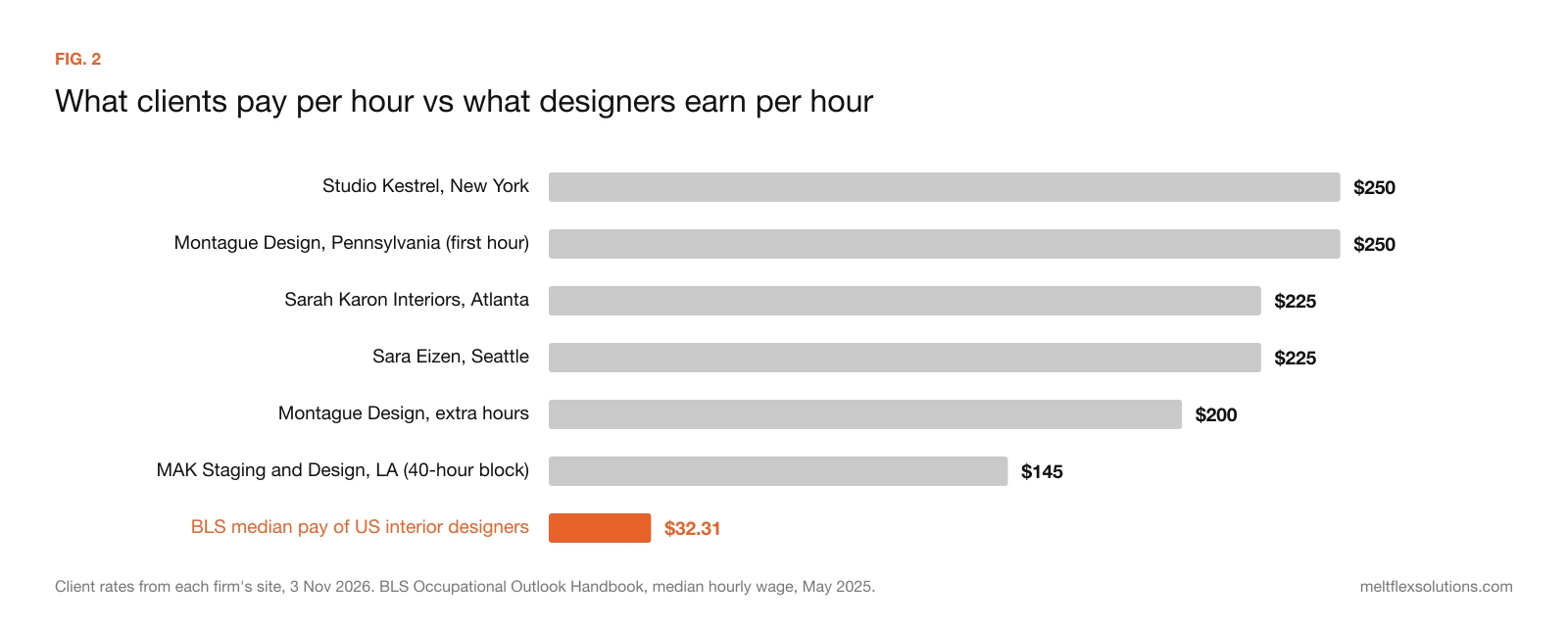
That gap is not pure profit. A billed hour has to cover the hours that cannot be billed (marketing, unpaid first calls, chasing a late delivery), plus insurance, software, samples, the trade accounts and, at a studio, the owner and staff. Many designers on the BLS count are also employees of furniture stores or architecture firms, where the median is lower ($50,560 in retail) or higher ($78,340 in architectural and engineering services). The practical takeaway: a designer charging $100 an hour is not necessarily a bargain, and one charging $250 is not necessarily overpriced. Judge the estimate for the whole job.
The furniture is the real bill
For full-service work, the design fee is usually the smaller number. Designers set minimum furniture budgets because they do not want to spend 40 hours designing a room that gets furnished from a discount site. In our sample:
- $15,000 minimum furniture budget per room alongside a $3,500 design fee (Tallahassee, Florida).
- $25,000 per space and up as the minimum furnishings investment (San Antonio, Texas).
- $35,000 per room as the starting furnishing investment (New York, serving clients nationwide).
- $75,000 minimum total budget for full service (Annapolis, Maryland).
So the realistic entry ticket for full-service design of one living room, from the published numbers, is around $18,500 to $40,000 including furniture, before any markup. If your total budget is $10,000, full service is not the product for you, and a good designer will tell you so on the first call.
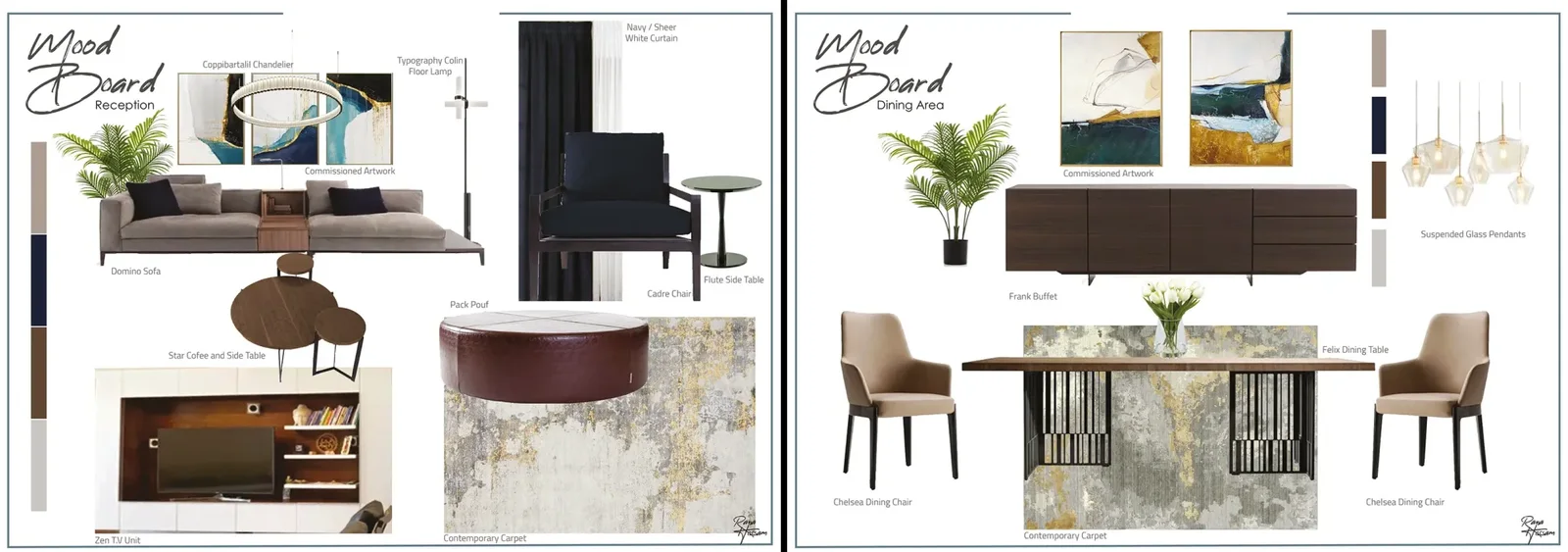
Every cut-out on a board like this is a product someone has to buy, so the board is really a furniture budget. Project: Mood Boards For A Residential Apartment by Rana Hossam on Behance.
How much does online interior design (e-design) cost?
E-design means you send photos, measurements and a style questionnaire, and a designer sends back a concept board, a floor plan and a shopping list with links. You buy and assemble everything yourself. Published prices per room:
| Service | Price per room | Notes |
|---|---|---|
| Havenly | $199 list for online design, $699 for in-person | Runs frequent discounts; we saw $89 and $299 sale prices |
| Spacejoy | $199, $399 or $599 (shown discounted from $399, $599 and $799) | One or two concepts depending on the tier |
| Decorilla | $849 to $2,805 for a living room | Four tiers; bedroom $769 to $2,640, kitchen $1,089 to $3,080 |
| Independent designers | $348 to $1,800 | Los Angeles and Nashville designers, priced by tier or room size |
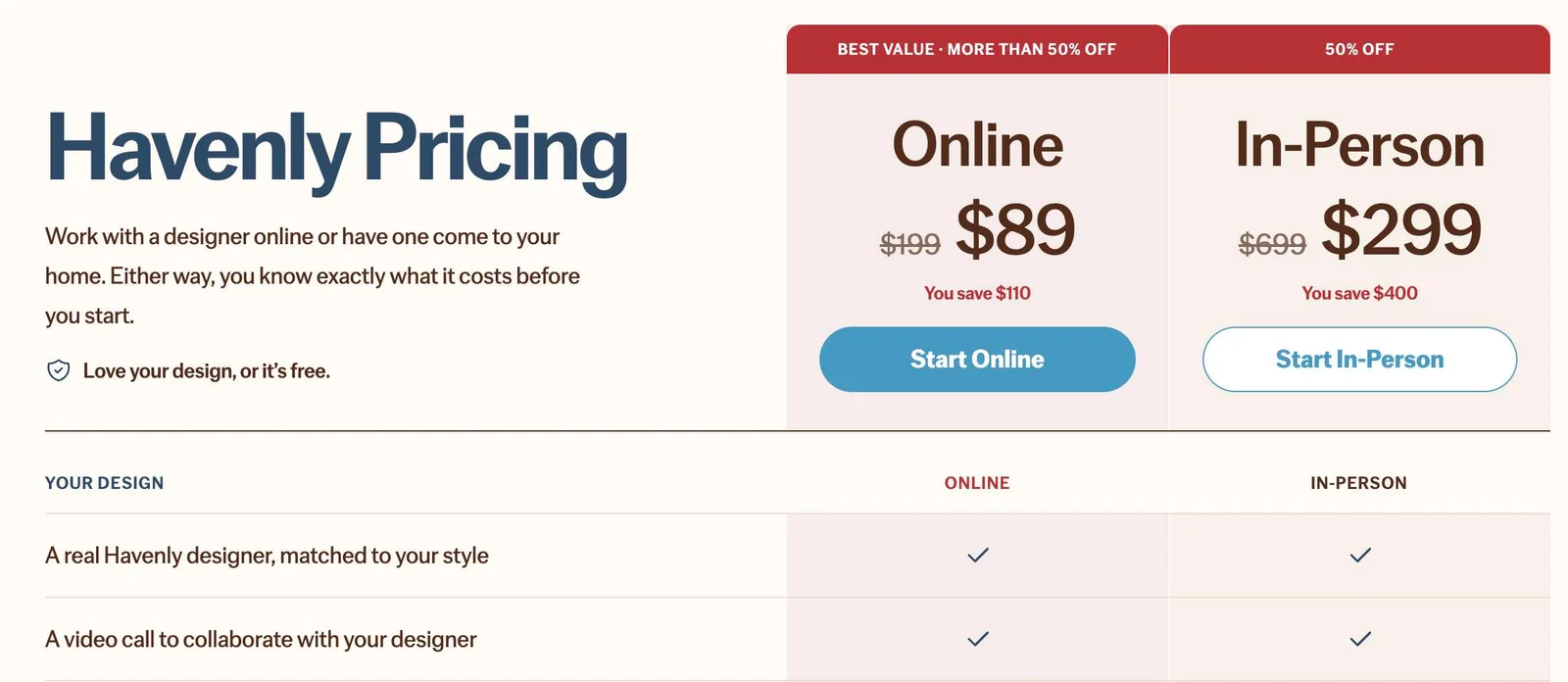
Havenly's pricing page as we saw it on 3 November 2026. The struck-through prices are the list prices; the sale prices change often. Screenshot: havenly.com/pricing.
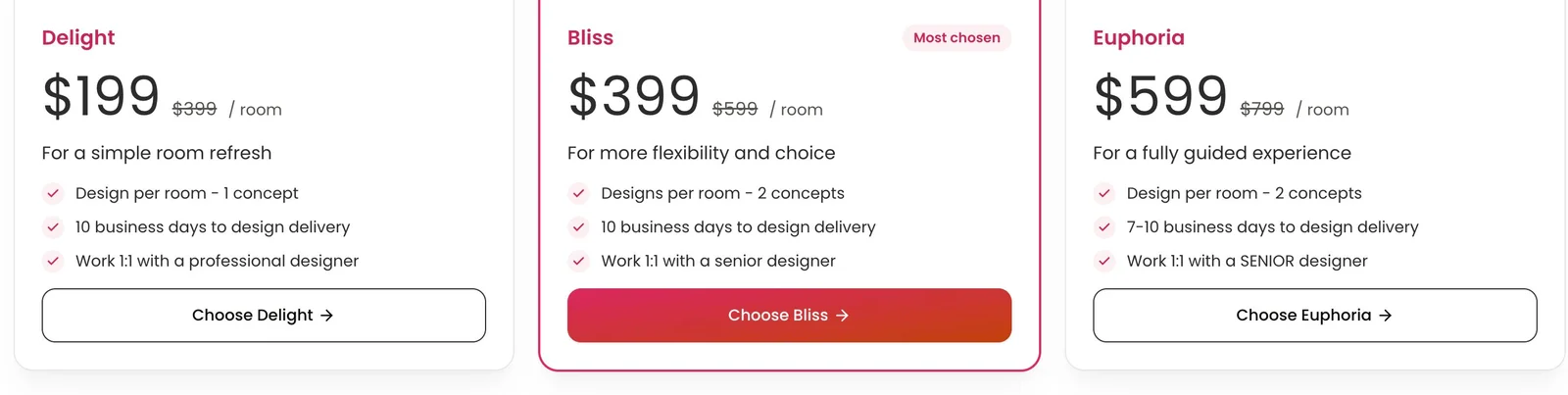
Spacejoy's three per-room tiers on the same day, also shown as discounted. Screenshot: spacejoy.com/pricing.
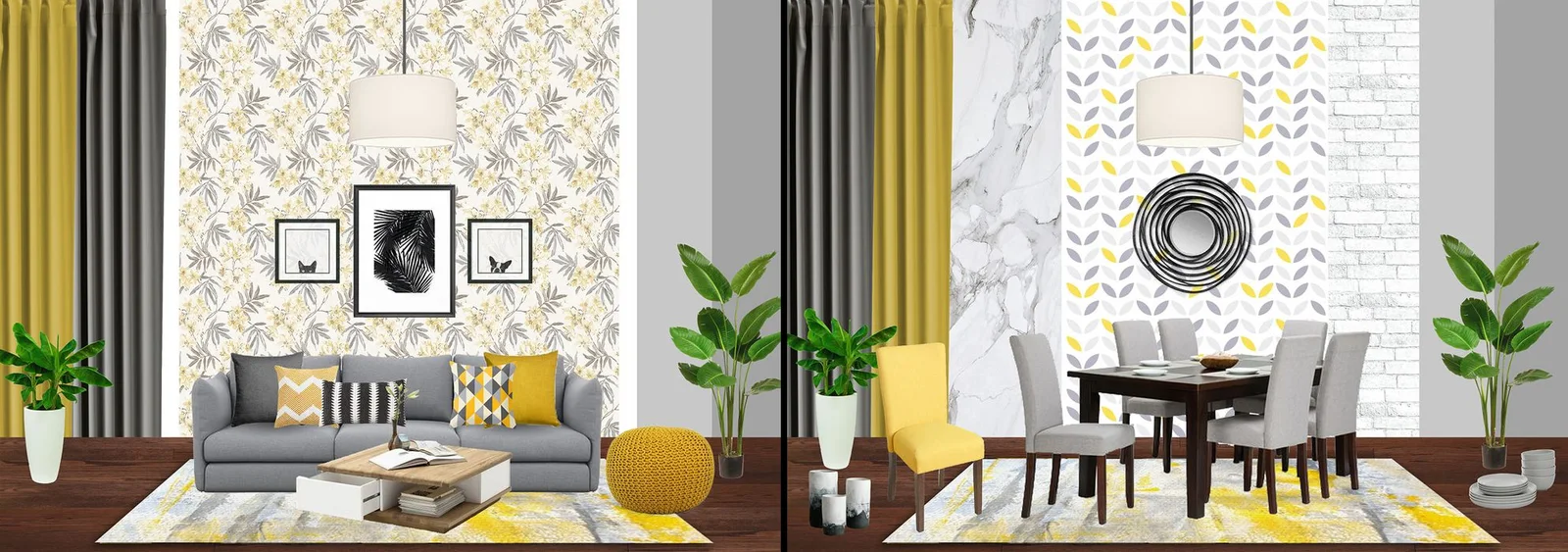
A typical e-design deliverable: a styled board per room with the products and finishes you then buy yourself. Project: Interior Styling Mood Boards #2 by Soumya Jain on Behance.
E-design is real design work at a fraction of the price, but you become the project manager. You order, track, return damaged items and decide what to do when the chosen sofa is discontinued. It also carries a risk that is rarely mentioned: online design companies close. Homepolish collapsed in 2019, and both Modsy and Decorist shut down in 2022, according to Business of Home. Pay per room, not a large prepaid package.
Free design services from furniture retailers are a separate category. Ethan Allen, for example, describes its design service as complimentary. The cost is that the plan is built around one store's catalogue.
Interior designer vs architect: who you need and what it costs
People often price an interior designer when they actually need an architect, or the other way round. A simple rule:
- Moving or removing walls, adding space, changing structure, stairs, windows or anything that needs a building permit: you need an architect (or, for some single-family work, a licensed engineer or building designer, depending on your state). Interior designers in most states cannot stamp construction drawings.
- Layout of furniture, finishes, lighting, colors, cabinetry inside the existing shell: an interior designer.
- Choosing furniture, fabrics and accessories only: a decorator, or a designer for a day. Few US states restrict who may practice interior design, and in most of them anyone can call themselves a decorator. Check your state board if a credential matters to you.
What architects cost is harder to pin down than designers, because few publish prices. A Seattle firm states that its residential fees run 8 to 20% of construction cost, mostly billed hourly. A Kirkland, Washington architect quotes fixed fees for design and permit of about $10,000 to $200,000 depending on scope. On a $400,000 renovation, 8 to 20% is $32,000 to $80,000, which is in the same territory as a full-service interior design fee for a whole home. Large projects often use both: the architect for the building, the interior designer for everything inside it. We put the published fees of US architects side by side in a separate guide: how much does an architect cost.
If you are still at the stage of "what could this space even become", it can save paid hours to arrive with something concrete. We make two tools for that first step, and we will be clear about their limits. AIBIMTool turns a written brief into a first 3D building model and an IFC file, which an architect can open; it does not replace the architect's drawings or permit set. MeltFlex AI restyles a photo of an existing room, which helps you decide what you like before you pay a designer to ask.
What one living room costs on each route
To make the numbers comparable, here is one example: a living room of about 300 sq ft, with a furniture budget of $10,000 for the routes where you choose the budget. The design fees are the published prices above. The $10,000 and the 20 hours are our assumptions, and markup is ignored.
| Route | Design cost | Furniture | Total |
|---|---|---|---|
| Do it yourself with an AI preview | €19 for one month of MeltFlex AI Standard | $10,000 | about $10,000 |
| E-design | $199 to $2,805 | $10,000 | $10,199 to $12,805 |
| Designer for a day | $1,049 to $2,400 | $10,000 | $11,049 to $12,400 |
| Hourly, 20 hours | $2,900 (prepaid block) to $5,000 ($250/h) | $10,000 | $12,900 to $15,000 |
| Full service, flat fee | $3,500 to $5,000 | $15,000 to $35,000 minimum | $18,500 to $40,000 |
The table shows the trade-off in money; what it cannot show is risk and time. The cheaper routes put the mistakes on you: wrong scale, a rug that is too small, a sofa that does not fit through the door. Part of what a full-service designer sells is that their mistakes are theirs to fix.
How to pay less for an interior designer
- Use AI to choose your style before you pay anyone. Working out what a client likes is one of the most expensive parts of a designer's time. With MeltFlex AI (which we make) you upload a photo of your own room and see it restyled in seconds, so you can compare warm Japandi, Scandinavian or a dark, moody look for the price of a monthly plan (€19 on Standard, up to 100 renders) instead of $200 to $250 an hour. For a simple room that may be all the "design" you need; for a bigger project, bring the pictures to your first meeting as references and you will need fewer paid hours. Do not treat them as a plan: the furniture and proportions in an AI render are not measured, and someone still has to check what actually fits.
- Buy a design day instead of full service if you are happy to do the ordering yourself. It is the best price per hour in our sample.
- Arrive with a clear brief. Measurements, photos, a budget and the images of rooms you like. Every hour a designer spends working out your taste is an hour you pay for.
- Ask how markup works before you sign, and whether you can buy some items yourself.
- Ask for the consultation fee to be credited against the project if you go ahead.
- Pay e-design per room, not a prepaid multi-room bundle.
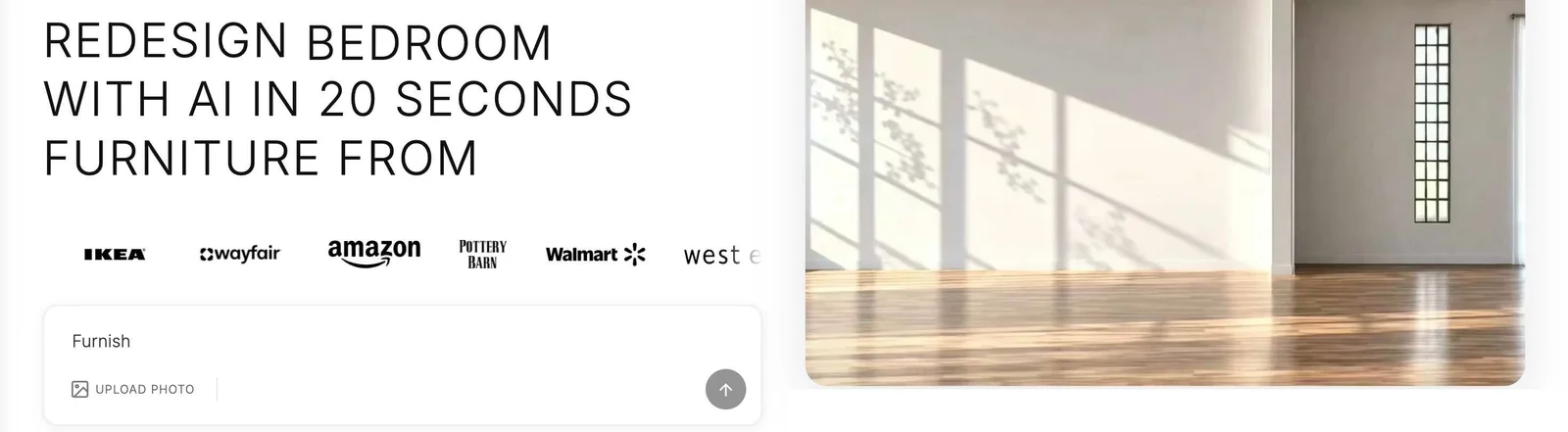
The MeltFlex AI start screen: upload a photo of your room, pick or type a style, and compare versions before you spend on a designer. Screenshot: meltflexai.com, 3 November 2026.
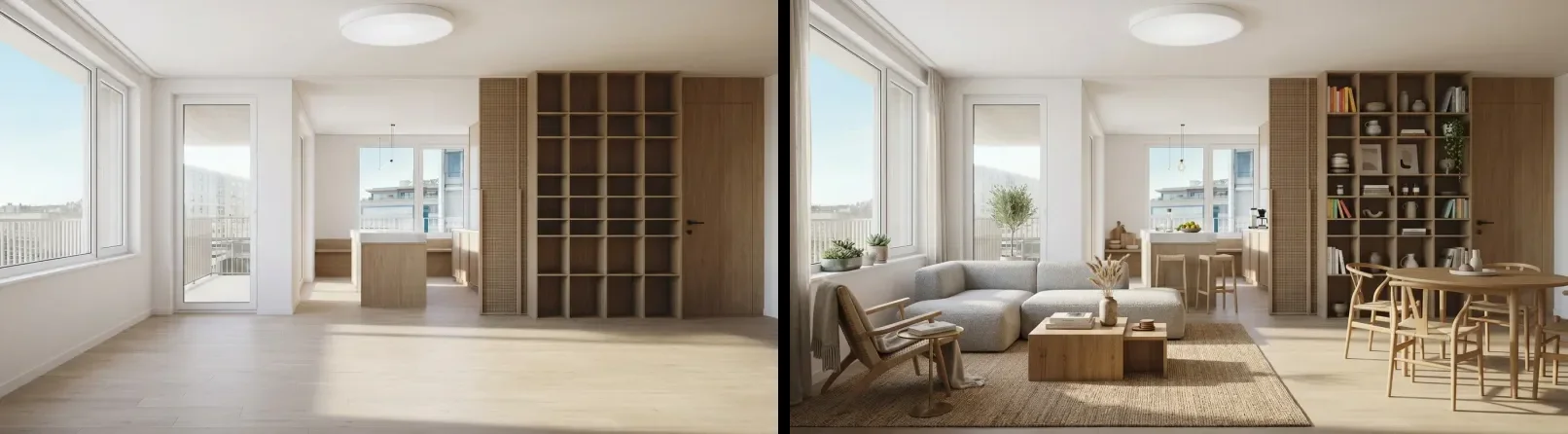
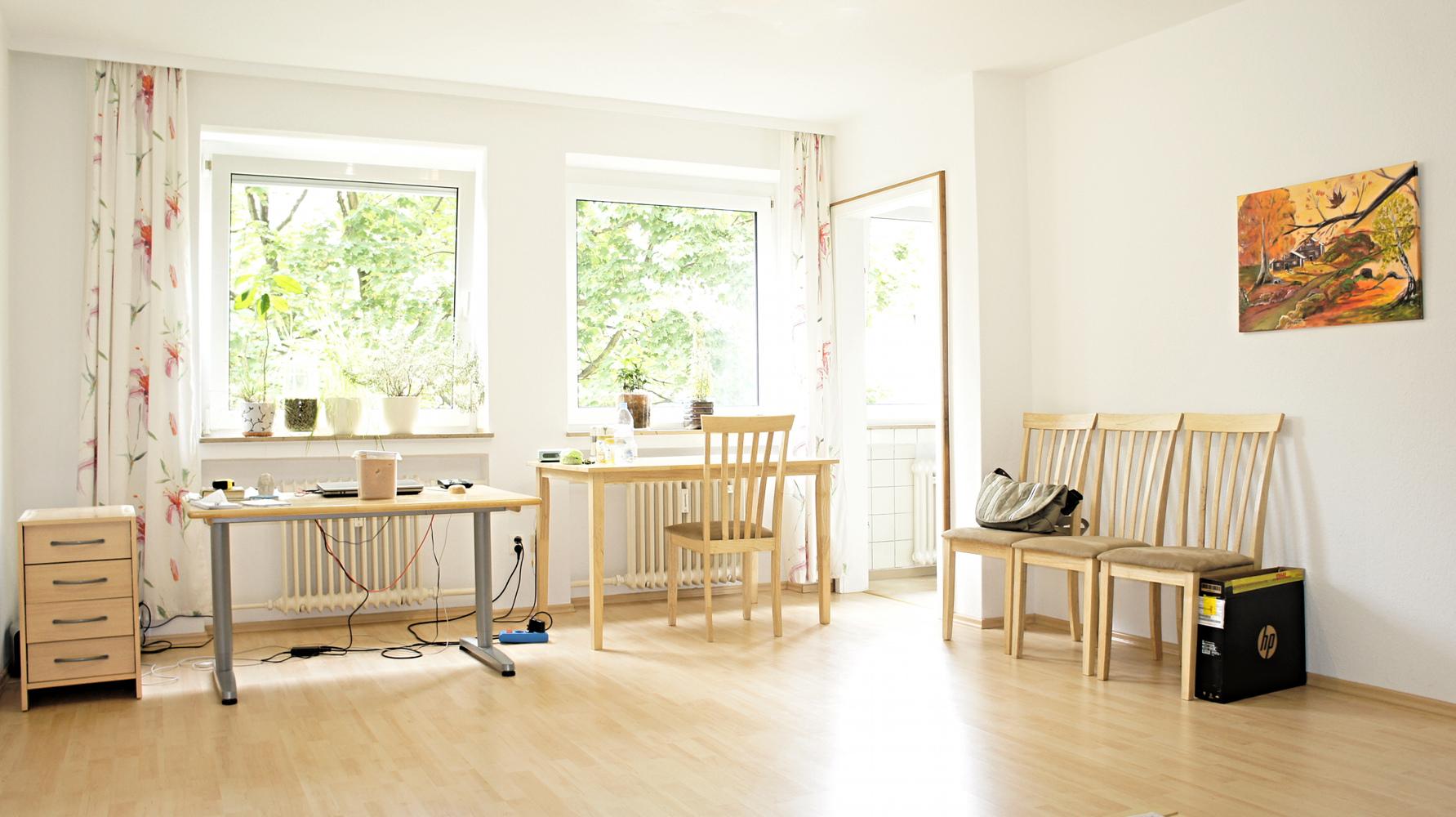
An empty room and the same room furnished by MeltFlex AI, from the product's own demo. Useful for choosing a direction; not a substitute for a measured layout.
Is an interior designer worth it?
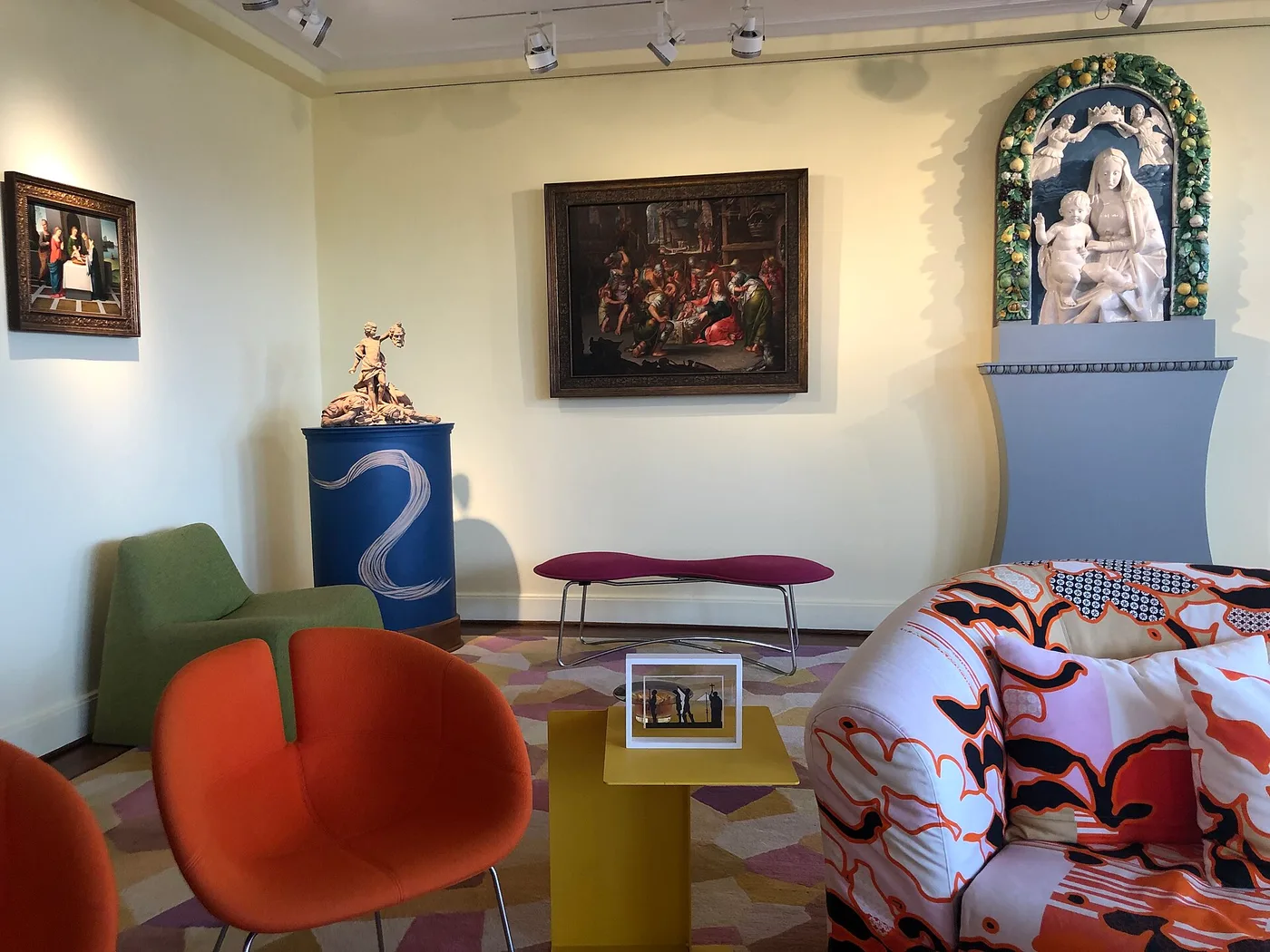
The far end of the range: a living room by New York interior designer Hester Diamond, known for mixing contemporary furniture with Old Master art. Photo: Rachel Kaminsky, CC BY-SA 4.0.
This is our opinion, not a measured result. A designer is worth the money when the cost of a mistake is high: a renovation where cabinetry, lighting and electrical positions are fixed for 20 years, a whole home furnished at once, or a budget large enough that a designer's trade pricing and judgement pay for part of the fee. They are hard to justify when you are furnishing one room on a budget under the designer's own minimum, or when you mostly need someone to pick colors, where a consultation or a design day gives you most of the value for 5 to 10% of the price.
Questions people ask about interior designer costs
How much does an interior designer cost per hour?
The US designers in our sample who publish hourly rates charge $200 to $250 an hour, and one Los Angeles studio sells prepaid blocks that work out to $145 to $150 an hour. Rates vary with location and experience, and some firms bill administrative work at a lower rate than design time.
How much does an interior designer cost for a whole house?
For full service, the published design fees start around $25,000 for a full home at a New York studio and $100,000 or more at high-end studios, before furniture. A Dallas studio quotes $15 to $21 per square foot for large renovations and new builds. Furniture and materials are on top and are usually the larger part of the total.
How much does an interior design consultation cost?
In our sample, a first consultation costs $200 to $700, usually for one or two hours. Some firms credit the fee against the project if you hire them.
Is an interior decorator cheaper than an interior designer?
Usually, because a decorator works only with furniture, fabrics, colors and accessories, not with layouts, construction drawings or contractors. Many designers also sell decorating-only services, such as a design day, at similar prices to decorators.
Do interior designers charge a percentage?
Some do. One San Antonio firm suggests budgeting 15 to 25% of the project for design fees, and many designers earn part of their income from a markup on furniture, typically quoted as a percentage over wholesale. Pure percentage-of-project fees were not published by any of the 19 firms we checked.
Is an architect or an interior designer more expensive?
On a large project they are often in the same range. Residential architects typically quote 8 to 20% of construction cost or a fixed fee, from about $10,000 to $200,000 in the examples we found. Full-service interior designers quote similar totals for whole homes. On a single room, an interior designer is far cheaper, and an architect is usually not needed at all.
Can AI replace an interior designer?
Not for a real project. AI room tools are good at showing a style quickly and cheaply, which helps you decide what you want. They do not measure, do not check that furniture fits or is buyable in your size, and do not manage orders or contractors. We cover what they do well in our guide to the best AI interior design tools.
How we made this guide
The prices are our own collection. On 3 November 2026 we opened the websites of US interior designers and online design services and recorded only numbers that the firm itself publishes on its pricing, services or FAQ pages, or in a cost article on its own site. We kept 19 firms across New York, New Jersey, Pennsylvania, Maryland, Texas, Florida, Tennessee, Georgia, Minnesota, Missouri, Washington, Oregon and California. We left out firms that publish only "typical market ranges" without their own prices (17 of them) and pages we could not open. Several numbers come from firms' blog posts rather than formal price lists, prices on Havenly and Decorilla change with promotions, and Decorilla's US dollar prices were taken from the page's price data because it showed euros to our location. Designers who publish prices are not a random sample: high-end studios that quote only on request are under-represented, so the real top of the market is higher than our chart shows.
Wage figures are from the BLS Occupational Outlook Handbook (May 2025 data). Architect fees come from two architects' own pages, one of them from 2015. The living room comparison uses our own assumptions for the furniture budget and hours, stated above. Search demand was checked in Ahrefs Keywords Explorer for the US.
The author, Matúš Koleják, builds design and BIM software at MeltFlex; he is not an interior designer and did not hire any of the firms listed. Disclosure: MeltFlex s.r.o., which publishes this blog, makes MeltFlex AI (shown in the sidebar) and AIBIMTool, both mentioned above. No designer or service in this guide paid to be included, and the MeltFlex AI price is taken from its public pricing page on the same day.
Sources and further reading
- BLS Occupational Outlook Handbook, Interior Designers: median pay, employment and pay by industry.
- Designers' own pricing pages: Studio Kestrel, BEH Interiors, The NYC Interior Designer, CRAFT by Anika, Montague Design, Details & Design, Paige Studio, Styleberry Creative, {e}Xtraordinary by Design, Jennifer Taylor Design, JL Design Nashville, Sarah Karon Interiors, Happy Place Interiors, Nisha Tailor Interior Design, Sara Eizen, Design With Refinement, Connie Glazer Design, The Designer Flip, MAK Staging and Design.
- Markup policies: Etch Design Group, Pembrook Interiors, DFI Interiors.
- Online services: Havenly pricing, Spacejoy pricing, Decorilla pricing, Ethan Allen design services.
- Closures: Business of Home on Modsy, Decorist and Homepolish.
- Architect fees: Board & Vellum (2015) and Piper Cole Architects (2026).
Renting and not allowed to change much? Our guide to AI interior design for renters shows how to test a room before you buy anything. Running a design studio and losing hours to sourcing, quoting and follow-ups? Book a free call and we will show you which parts can be automated.
Image credits: interior design projects published on Behance, credited under each picture, cropped and combined to fit the page and otherwise unedited: Eugenio Ettore Alemanni, ulfat ktaifan, Rana Hossam, Space L Design Studio, Dimora Interiors, Tetiana Visual 3D and Soumya Jain. Living room photo by Rachel Kaminsky, CC BY-SA 4.0, via Wikimedia Commons, resized. Screenshots of Havenly, Spacejoy and MeltFlex AI taken on 3 November 2026. Charts by MeltFlex Solutions from the published prices listed above. Before and after pair from the MeltFlex AI demo.
More articles
Share article