Most Durable Couch Fabric: What Rub Counts Really Say
 Matúš Koleják

Illustrations generated with AI by MeltFlex from reference interiors. They show fabric types, not specific products.
Every sofa retailer tells you its fabric is durable. Very few tell you how they know. The number that is supposed to settle it, the rub count, is printed on some listings, missing from most, and misunderstood on nearly all of them.
This guide is built on documents, not on a showroom. We did not rub-test fabric ourselves and we did not live with these sofas. We read what fabric mills and sofa retailers publish, the guidelines of the Association for Contract Textiles (ACT), a mill's own technical paper on why abrasion numbers mislead, and the largest owner survey we could find. Where something is our judgment and not a measured fact, we say so.
What is the most durable couch fabric?
There is no single winner, because fabrics fail in different ways: they wear through, pill, snag, stain, fade or peel. Here is how the common options compare on the failure that usually ends them. The "weak point" column is the one to read.
| Fabric | What it is | Strong at | Weak point |
|---|---|---|---|
| Polyester (incl. microfiber, most velvet and chenille) | Synthetic fiber, the default on mid-priced sofas | Abrasion, colour, price | Can pill; oily stains; quality varies widely |
| Olefin (polypropylene) | Synthetic, coloured in the melt | Stains, bleach, fading | Low melting point, attracts oily soil |
| Solution-dyed acrylic | Synthetic, pigment through the whole fiber | Sun and bleach | Abrasion ratings are often modest |
| Nylon blends | Synthetic, often a small share of a blend | Strength | Rarely used alone on sofas |
| Wool and wool blends | Natural | Least owner-reported damage | Price; blends can pill |
| Cotton and linen | Natural | Comfort, washable slipcovers | Stains, wrinkles, more reported wear |
| Top-grain leather | Real hide | Wipes clean, ages rather than wears | Scratches, cat claws, price |
| Bonded and faux leather | Polyurethane surface on a backing | Cheap, wipes clean at first | Peeling and cracking |
Our reading of the evidence, and it is a judgment: for a busy household the safest buy is a tightly woven synthetic or synthetic blend with a stated rating of at least 30,000 double rubs, in a mid-tone or patterned colour, with removable cushion covers. The fiber name on its own is not enough to go on. In the listings we read, one 100% polyester sofa fabric was rated at 15,000 and another at 100,000, and a 100% linen at 42,000.
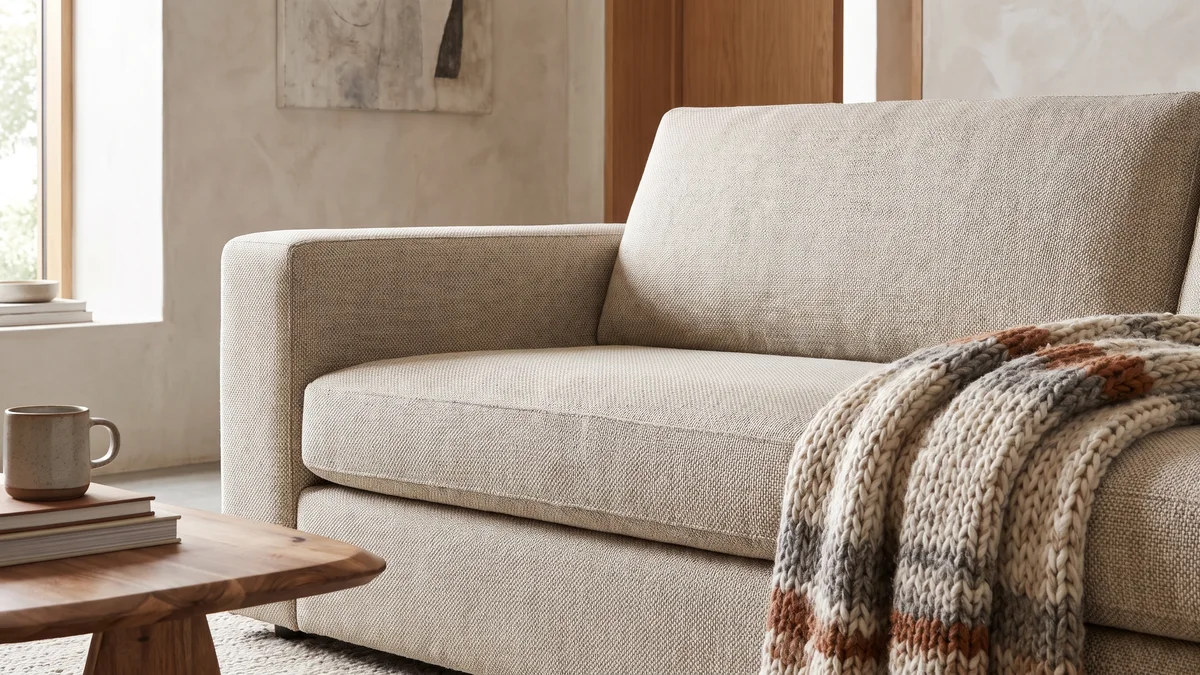
AI illustration by MeltFlex. A flat, tight weave like this gives claws and buckles little to catch on.
What a rub count actually measures
A machine rubs the fabric until two yarns break or the wear becomes obvious. There are two machines, and their numbers are not interchangeable:
- Wyzenbeek (ASTM D4157), common in North America. A piece of cotton duck is rubbed back and forth along the fabric. One back-and-forth is one double rub.
- Martindale (ASTM D4966, ISO 12947-2), common in Europe. A wool cloth is rubbed in a figure-eight under pressure. The unit is cycles, often written as rubs.
Camira, a British mill, puts the relationship bluntly in its technical paper on the subject: "There is absolutely no correlation between the tests." You cannot convert one into the other. ACT's guidelines pair 15,000 Wyzenbeek with 20,000 Martindale and 30,000 with 40,000, which is a pairing of thresholds, not a conversion formula.
Both tests measure flat abrasion only. ACT says so directly: they "do not consider edge abrasion". That matters because sofas usually wear first on piping, cushion edges and arm fronts. They also say nothing about pilling, snagging, staining, fading or seams, each of which has its own test.
How many double rubs does a sofa need?
ACT's guidelines were written for commercial interiors, and the home furniture trade borrows them because nothing equivalent exists for houses. They set two lines for woven upholstery:
- 15,000 double rubs (or 20,000 Martindale): suitable for commercial low-traffic and private spaces.
- 30,000 double rubs (or 40,000 Martindale): suitable for commercial high-traffic and public spaces.
A family sofa that is used every evening is easier duty than a hotel lobby chair. So a fabric that meets the 30,000 line has cleared the bar for abrasion, and a fabric at 15,000 is acceptable for normal home use.
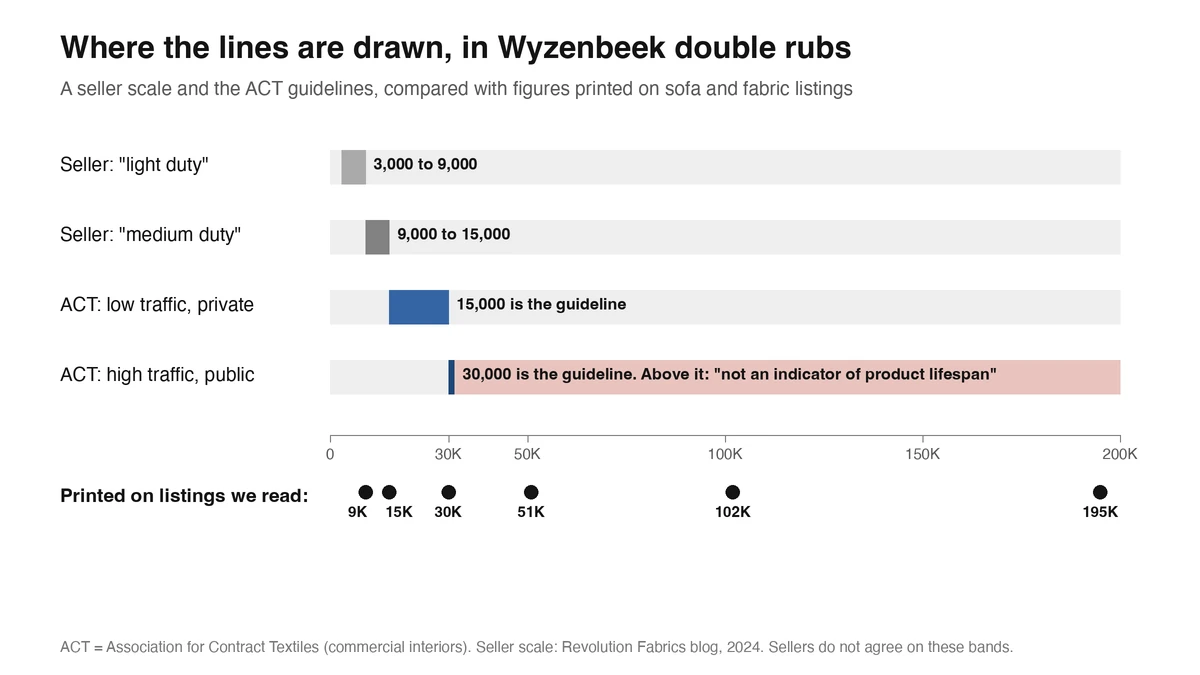
Chart by MeltFlex from ACT guidelines, a Revolution Fabrics article and the listings described below.
Sellers publish their own scales, and they do not match. Revolution Fabrics calls 15,000 and up "heavy duty". American Leather starts heavy use above 20,000 and says residential fabrics run between 10,000 and 25,000. These are marketing bands, not standards.
Why 100,000 is not three times better than 30,000
This is the part most guides get wrong, so here are the sources.
ACT states that "abrasion test results exceeding ACT Performance Guidelines are not an indicator of product lifespan" and that "higher abrasion numbers do not necessarily indicate a significant extension of the fabric's service life". It also reports that results on the same fabric vary significantly from test to test.
Camira tested one of its own fabrics 19 times. The results ran from 32,000 to 78,000. Same fabric, same test, more than double from the lowest to the highest. Camira's conclusion is that results above 100,000 cycles are not meaningful for predicting extra longevity.
So treat the rub count as a pass mark. Under 15,000, ask questions. Between 15,000 and 30,000 is fine for a home. Past 30,000, stop comparing the number and look at weave, pilling, cleaning and colour instead.
We read 193 "performance" fabric listings
To see how much the word performance guarantees, we read every upholstery fabric in the product feed of Revolution Fabrics on 11 November 2026. Revolution is a North Carolina mill that sells solution-dyed olefin and polyester fabrics under a performance label, and, to its credit, it prints a double rub figure on most of them. Of 206 fabrics, 193 list one.
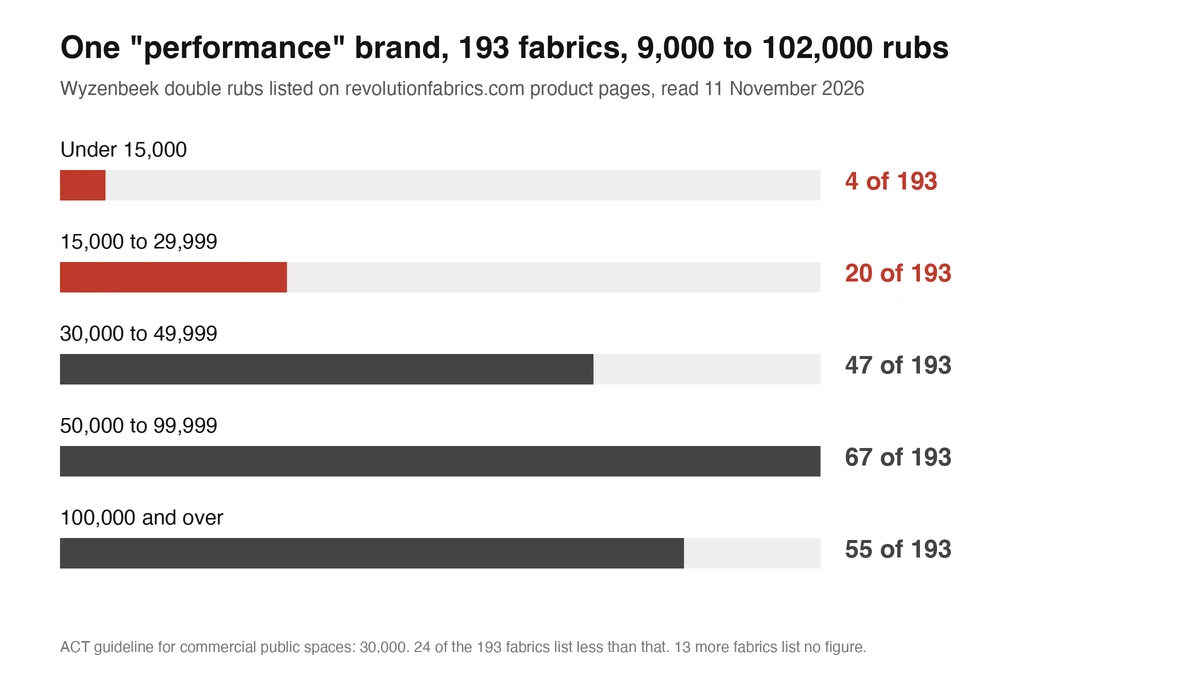
Chart by MeltFlex from revolutionfabrics.com product pages, 11 November 2026.
- The ratings run from 9,000 to 102,000 double rubs. The median is 60,000.
- 24 of 193 sit below the 30,000 line, and 4 are below 15,000.
- 50 fabrics list exactly 102,000. That clustering suggests testing that stops shortly after 100,000, which is common practice, and it fits ACT's point that nobody should read meaning into bigger numbers.
- Fabrics with "Performance" in the product name range from 15,000 to 102,000.
None of this says Revolution's fabrics are poor. A 15,000 fabric from a mill that publishes the figure is a more informed buy than an unrated fabric from a brand that does not. The point is narrower: one brand, one label, an elevenfold spread. The label is not the spec.
Trade insiders say the same. In a Business of Home article on the term, a fabric executive is quoted: "No one has actually defined what performance is."
What sofa listings tell you
We also looked at how sofa retailers present the number, using product pages from two US stores on the same day.
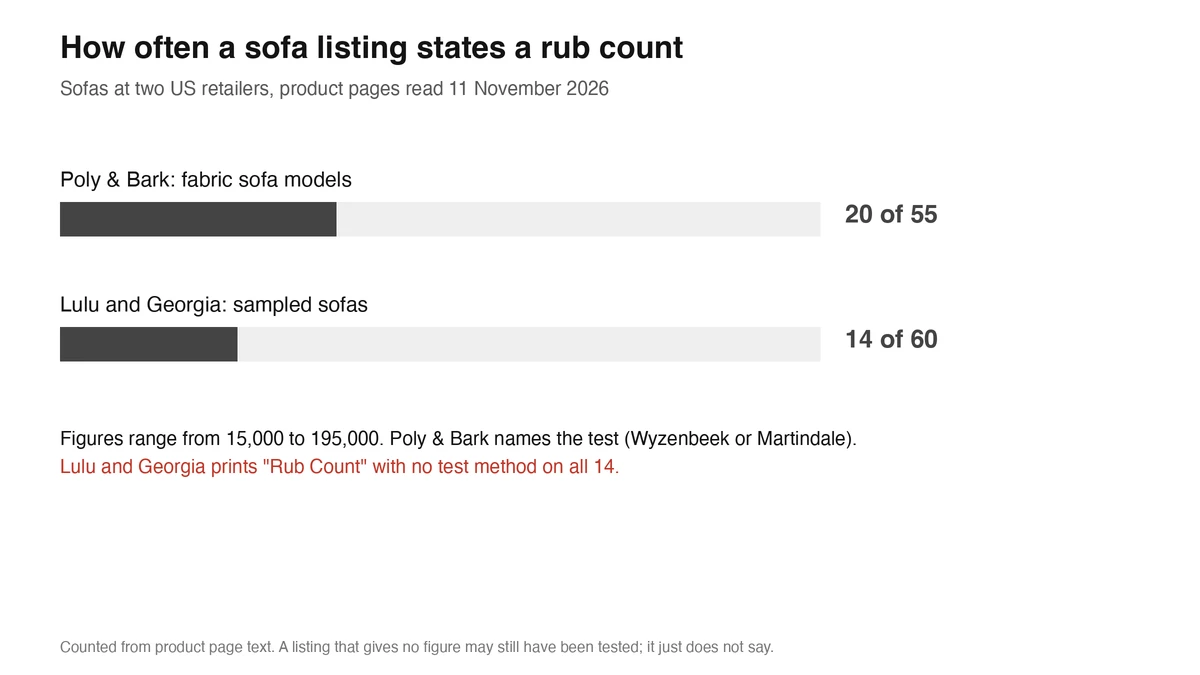
Chart by MeltFlex from polyandbark.com and luluandgeorgia.com product pages, 11 November 2026.
- Poly & Bark: 20 of 55 fabric sofa models state a rub count and name the test. Some fabrics are quoted in Wyzenbeek (30,000 to 100,000) and others in Martindale (30,000 to 100,000), sometimes on the same sofa in different colours.
- Lulu and Georgia: 14 of the 60 sofas we sampled show a "Rub Count", from 15,000 to 195,000. None of the 14 says which test produced it.
A rub count with no test name is half a number. If a listing gives one, ask which method. If it gives none, ask for it. A retailer that knows its fabric can answer in one email.
What is performance fabric?
Performance fabric is a marketing term for upholstery sold as easier to clean and harder to wear out. It has no legal or industry definition. What you actually get depends on the brand, and the brands differ a lot:
| Brand | What it is | Published abrasion | Warranty stated by the brand |
|---|---|---|---|
| Crypton Home | A treatment applied to many fibers, synthetic or natural | No number on the spec sheet | 2 years |
| Sunbrella | Acrylic | Per fabric; one listing we saw says 85,000 | 5 years limited |
| Revolution | Solution-dyed olefin and polyester | Per fabric; 9,000 to 102,000 | Up to 3 years indoors |
| Perennials | 100% solution-dyed acrylic | Per fabric; one lists 12,000 | 5 years, colour loss only |
| LiveSmart | Polyester and polyester blends | 15,000, labelled "heavy duty" | Not found |
| InsideOut | Solution-dyed olefin with polyester | No number on the brand site | 3 years limited |
Two things stand out. Some of the most expensive performance fabrics carry modest abrasion ratings, because what they are engineered for is sun and bleach, not friction. And the warranties are short next to the "lifetime" language in adverts.
Crypton fabric
Crypton is not a fiber. According to the company, each fiber is encapsulated with its treatment in an immersion process, and the treatment can go on polyester, nylon, olefin, acrylic, cotton or wool. Crypton Home, the residential line, is made without the moisture barrier used on its contract fabrics. Its spec sheet lists liquid repellency and stain release test results but no rub count, only "enhanced abrasion resistance". The company states that since 1 October 2022 all production is PFAS-free. For pets it claims a tight weave that helps resist "minor snags from cat claws", which is a careful sentence and not a scratch-proof promise.
Olefin fabric
Olefin is the textile name for polypropylene. The US Federal Trade Commission defines it as a fiber made of at least 85% ethylene, propylene or other olefin units. It cannot be dyed in the usual way, so pigment is mixed into the melt before the fiber is spun. That is why it resists stains and bleach: there is no dye sitting on the surface to strip, and the fiber absorbs almost no water.
Its weaknesses are just as specific. Polypropylene melts at around 165°C (330°F), far lower than polyester, so a hot iron or pan will mark it, and Camira notes that the friction heat of an abrasion test can itself lower its results. It also holds on to oily soil, which is why olefin sofas can look grubby on the arms and headrest long before they wear.
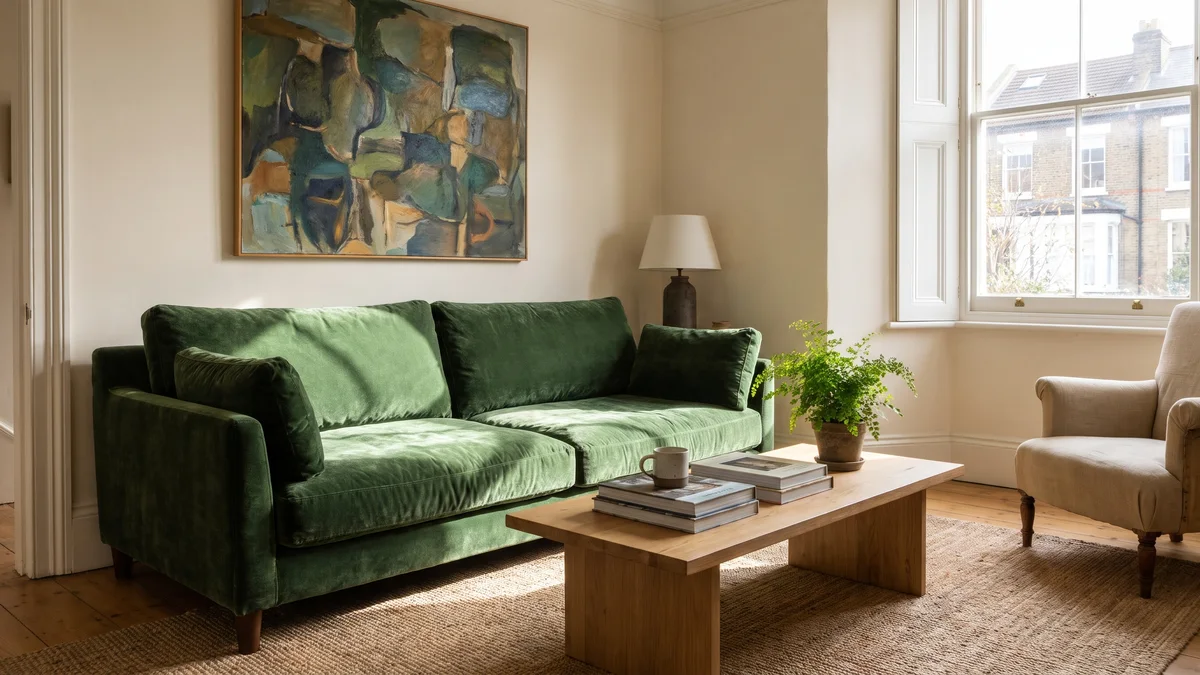
AI illustration by MeltFlex. Most sofa velvet today is polyester; the pile hides wear but shows pressure marks.
What 1,333 sofa owners reported
Lab numbers describe new fabric. The best real-world data we found is a survey by Which?, the UK consumer organisation, of 1,333 people who had bought a sofa in the previous ten years. It asked whether the sofa had suffered damage or wear.
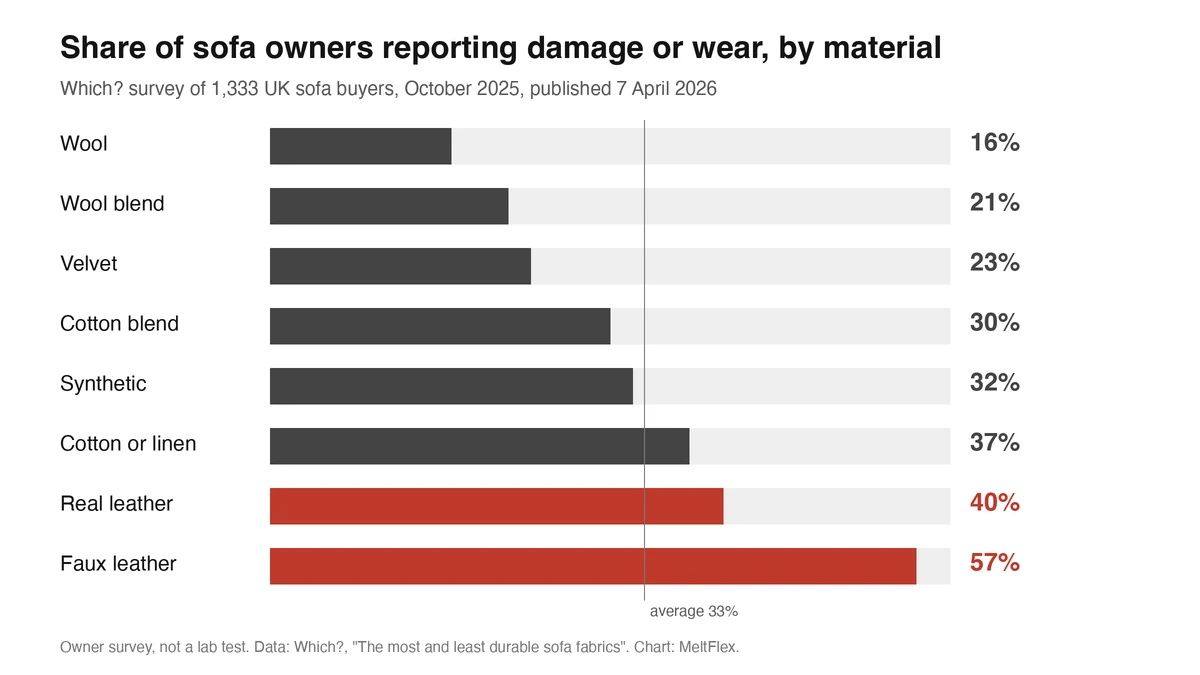
Data: Which?, survey of October 2025, published 7 April 2026. Chart by MeltFlex.
Read it with care. This is what owners noticed, not what a lab measured, and it does not control for price, pets or how old the sofa is. Wool sofas are often expensive and well made, which will flatter wool. Even so, two results are hard to argue with: faux leather was far worse than anything else, and Which? calls that gap statistically significant, and real leather did worse than its reputation.
Best couch material for dogs and cats
There is no industry test for claws. The closest standard, ASTM D3939, drags a spiked mace over fabric to measure snagging, and its own text says it is not considered satisfactory for acceptance testing because labs do not agree with each other. Any "claw-proof" claim is therefore a marketing sentence.
What the better sources agree on is the weave:
- Tight and flat is safest. Hill's Pet advises tightly woven fabrics and warns against loose weaves and looped upholstery. Boucle, tweed and loose chenille give a claw something to hook.
- Microfiber is a common recommendation for cats because there are no loops to pull, and it can take a few scratches.
- Leather is good with dogs and a risk with cats. Hair and dirt wipe off, but Hill's calls leather "a prime target for cat claws", and scratches in leather do not close.
- Cats scratch for a reason. The ASPCA notes cats scratch to shed worn claw layers and prefer material they can get their claws into. A scratching post next to the sofa does more than any fabric choice.
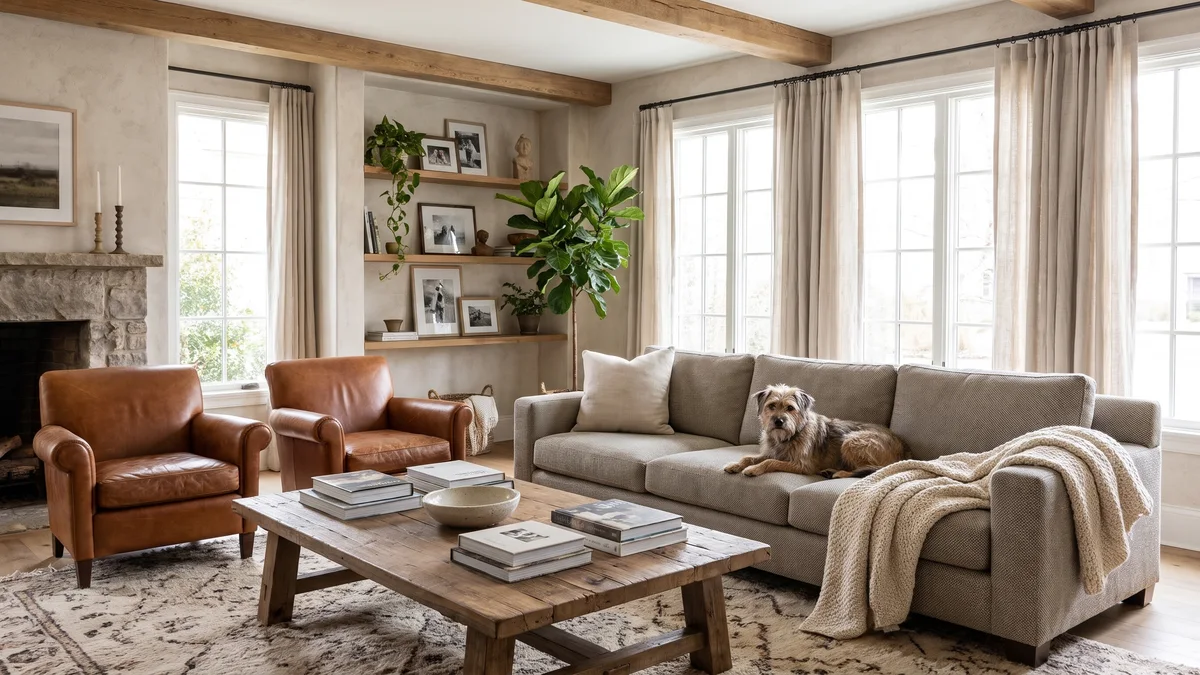
AI illustration by MeltFlex. For dogs, cleanability and a colour close to the coat matter more than the rub count.
For dogs, our advice is to prioritise removable, washable cushion covers, a mid-tone colour near your dog's coat, and a fabric with a W or WS cleaning code. For cats, choose the flattest weave you like and accept that no upholstery is immune.

AI illustration by MeltFlex. Looped boucle is the texture pet sources most often warn about.
Leather, bonded leather and faux leather
Top-grain and full-grain leather are single layers of real hide. They scratch and stain, but they do not delaminate, and many owners like how they age.
Bonded leather is different: ground leather fibers glued to a backing under a polyurethane surface. The FTC's leather guides say such material should not be called leather without disclosing its content, and give the example label "Bonded Leather Containing 60% Leather Fibers and 40% Non-leather Substances". Those guides were written for goods like shoes and bags; in 2019 the FTC was still asking whether to extend them to furniture. A 2016 ABC7 consumer report showed a bonded leather sofa flaking after about a year, with a repair specialist describing the coating peeling and bubbling.
That matches the survey above, where faux leather had the most reported damage. If the budget does not reach real leather, a woven fabric is the more durable choice at the same price. That is our opinion, but it is where both the survey and the repair trade point.
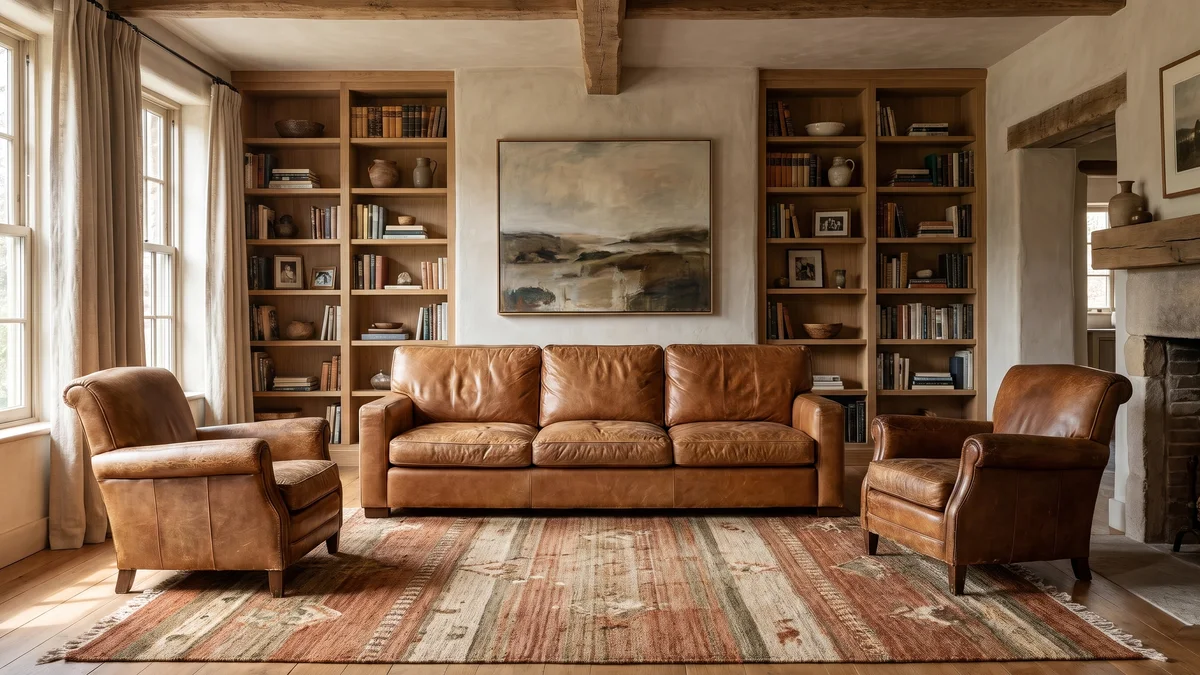
AI illustration by MeltFlex. Real leather creases and darkens with use; coated substitutes peel instead.
Cleaning codes: W, S, WS and X
The tag under the cushion carries a letter that decides how you can clean the sofa. The codes are an industry convention used by fabric makers:
| Code | Meaning |
|---|---|
| W | Water-based cleaners |
| S | Water-free solvent cleaners only |
| WS or W/S | Either water-based or solvent cleaners |
| X | Vacuum or brush only, no liquids |
For a household with children or pets, W or WS is worth more than an extra 50,000 rubs. An S or X fabric that cannot take water will look worn out from stains years before it wears through.
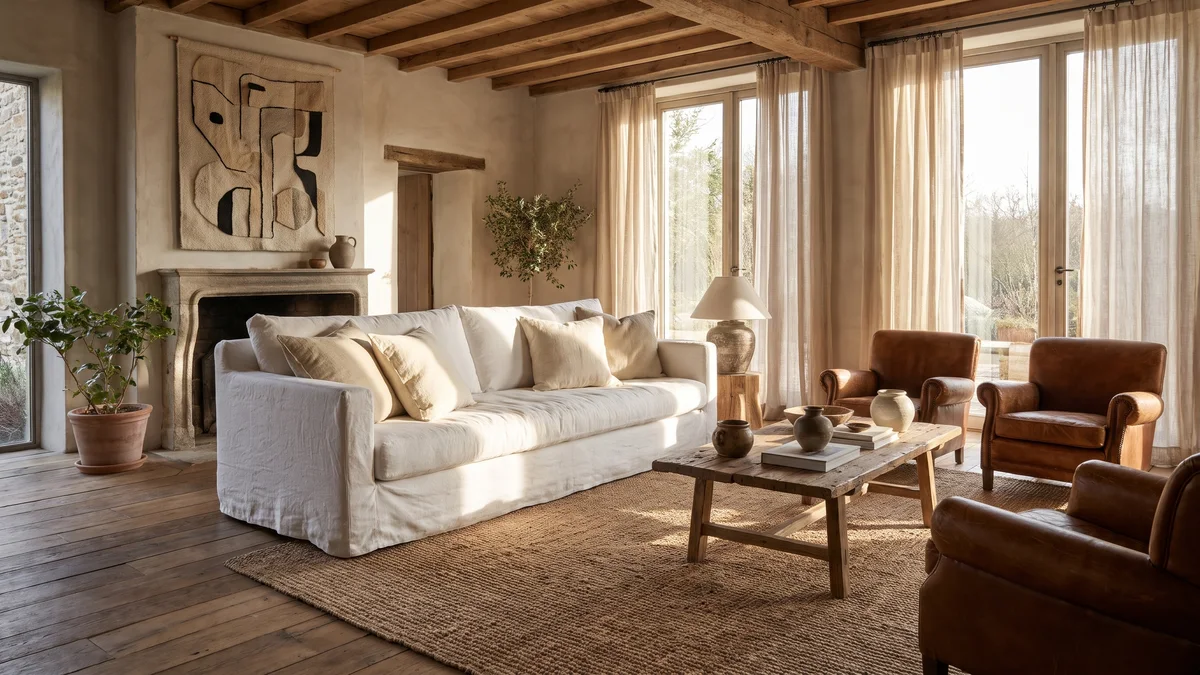
AI illustration by MeltFlex. Linen is not the toughest fiber, but a slipcover that goes in the wash solves a different problem.
Stain treatments and PFAS
Many stain-repellent finishes used fluorinated chemicals (PFAS). Several US states now restrict them in furniture. State sources we read set these dates for intentionally added PFAS:
- Minnesota: upholstered furniture and textile furnishings from 1 January 2025.
- Colorado: indoor upholstered furniture from 1 January 2025, outdoor from 1 January 2027.
- Maine: upholstered furniture from 1 January 2026.
- California: AB 1817 covers textile articles including upholstery from 1 January 2025, according to the law firm Morgan Lewis. We could not open the state's own page to confirm the wording.
In practice, ask whether the stain resistance comes from the fiber itself (solution-dyed olefin, acrylic or polyester) or from a finish. The first kind does not wear off. Also check whether adding your own spray protector voids the warranty: Revolution's FAQ says it does.
How to choose, in order
- Decide what will kill your sofa. Pets, children, sun, or simply ten years of sitting. Pick the fabric for that.
- Read the weave before the fiber. Tight and flat for claws and pilling. Pile fabrics hide wear but crush.
- Ask for the rub count and the test name. 15,000 double rubs is enough for a home, 30,000 is plenty. Do not pay extra for 100,000.
- Check the cleaning code. W or WS if anything will ever be spilled on it.
- Ask about pilling. ACT's guideline is Class 3 or better on a 1 to 5 scale.
- Prefer removable cushion covers. A zip is the cheapest durability feature there is.
- Order a swatch and scratch it with a key, spill coffee on it and leave it in a window for a week.
- Check the colour in your room. A swatch tells you about the fabric, not about how a three-seat block of that colour will look next to your floor and walls. An AI room visualiser such as MeltFlex AI can show the sofa colour in a photo of your own room before you order.
FAQ
What is the most durable furniture material?
For upholstery, a tightly woven synthetic or synthetic blend rated at 30,000 double rubs or more is the most dependable choice for wear. Real top-grain leather lasts a long time if scratches do not bother you. Faux and bonded leather are the least durable common option in owner surveys.
Is polyester a good couch fabric?
Yes, for most homes. It resists abrasion and holds colour, and it is the fiber behind most microfiber, velvet and chenille sofas. Quality varies, so check the rub count and ask about pilling. Oily marks from skin and hair are its main weakness.
Is chenille durable?
It depends on the construction. Chenille is a fuzzy yarn, not a fiber. Tightly woven polyester chenille can carry high rub counts, but the pile can crush and loose chenille can snag on claws. In the Revolution listings we read, the four fabrics sold simply as chenille ranged from 27,000 to 72,000 double rubs.
Is performance fabric worth it?
It can be, if you buy the property and not the word. Ask what makes the fabric a performance fabric: the fiber, a treatment, or both, and ask for the rub count, cleaning code and warranty length in writing.
How long should a sofa fabric last?
We found no reliable published figure, and anyone quoting an exact number of years is guessing. Wear depends on use, sun, cleaning and construction as much as on the cloth. In the Which? survey, a third of owners reported some damage or wear within ten years.
Is 100,000 double rubs better than 50,000?
Not in a way you can rely on. ACT says results above its guidelines are not an indicator of lifespan, and one mill's repeat tests of a single fabric ranged from 32,000 to 78,000.
How we made this guide
On 11 November 2026 we read the public product data of Revolution Fabrics (206 upholstery fabrics, 193 with a double rub figure) and recorded each stated rating. We read the product descriptions of Poly & Bark's fabric sofas (313 listings, grouped into 55 models) and sampled 60 sofa product pages at Lulu and Georgia, taking every third or so model from its catalog, and recorded whether a rub count and test method were given. Counts reflect what the pages say; a sofa with no stated figure may still have been tested.
We did not test any fabric. Statements about standards come from the organisations' own pages where we could open them. The ranking table, the "choose in order" list and the advice for pets are our judgment based on those sources. The Which? figures are theirs and come from a UK survey, so the mix of brands differs from the US market.
Sources and further reading
- Association for Contract Textiles: abrasion guidelines and physical properties of woven fabrics.
- Camira Fabrics, The Abrasion Debate (technical paper).
- Which?, The most and least durable sofa fabrics (7 April 2026).
- Business of Home, What does "performance" really mean? (26 November 2018).
- Revolution Fabrics: understanding double rubs and FAQ. American Leather, fabric rub tests.
- Crypton: FAQ and Crypton Home technical specifications.
- FTC: 16 CFR 303.7, generic fiber definitions and 16 CFR 24.2, leather guides.
- Martin Bide, Olefin Fibers, Encyclopedia of Clothing and Fashion.
- Hill's Pet, best couches and furniture for cat owners; ASPCA, destructive scratching.
- PFAS laws: Minnesota Statutes 116.943, Colorado HB22-1345, Maine 38 MRSA §1614, and Morgan Lewis on California AB 1817.
Choosing the sofa itself? See what the listings admit in our boneless couch reviews and how one brand's spec sheets hold up in Is Article furniture good quality?. Once the fabric is settled, our guide to standard table heights covers what goes next to it. Run a furniture business and want help with product data or customer questions? Book a free call.
Image credits: the six interior images and the cover collage are AI illustrations generated by MeltFlex from reference interiors; they do not show real products. Charts by MeltFlex Solutions from the sources named in each caption.
More articles
Share article