AI Interior Design with Plants and Planters
Plants are the last thing added to a render and the first thing that dies in the real room. That is not a coincidence. In an image, a plant is a shape that fills an empty corner and adds a colour the scheme was missing. In a home, a plant is a living thing with one non-negotiable requirement, and the render has no idea what that requirement is.
Which is a shame, because the plant question is one where a preview would help enormously. Most people are not unsure about whether they want greenery. They are unsure whether one large plant or five small ones, whether terracotta or matte black, and whether a two-metre tree in that corner would look considered or ridiculous. All of those are visual questions.
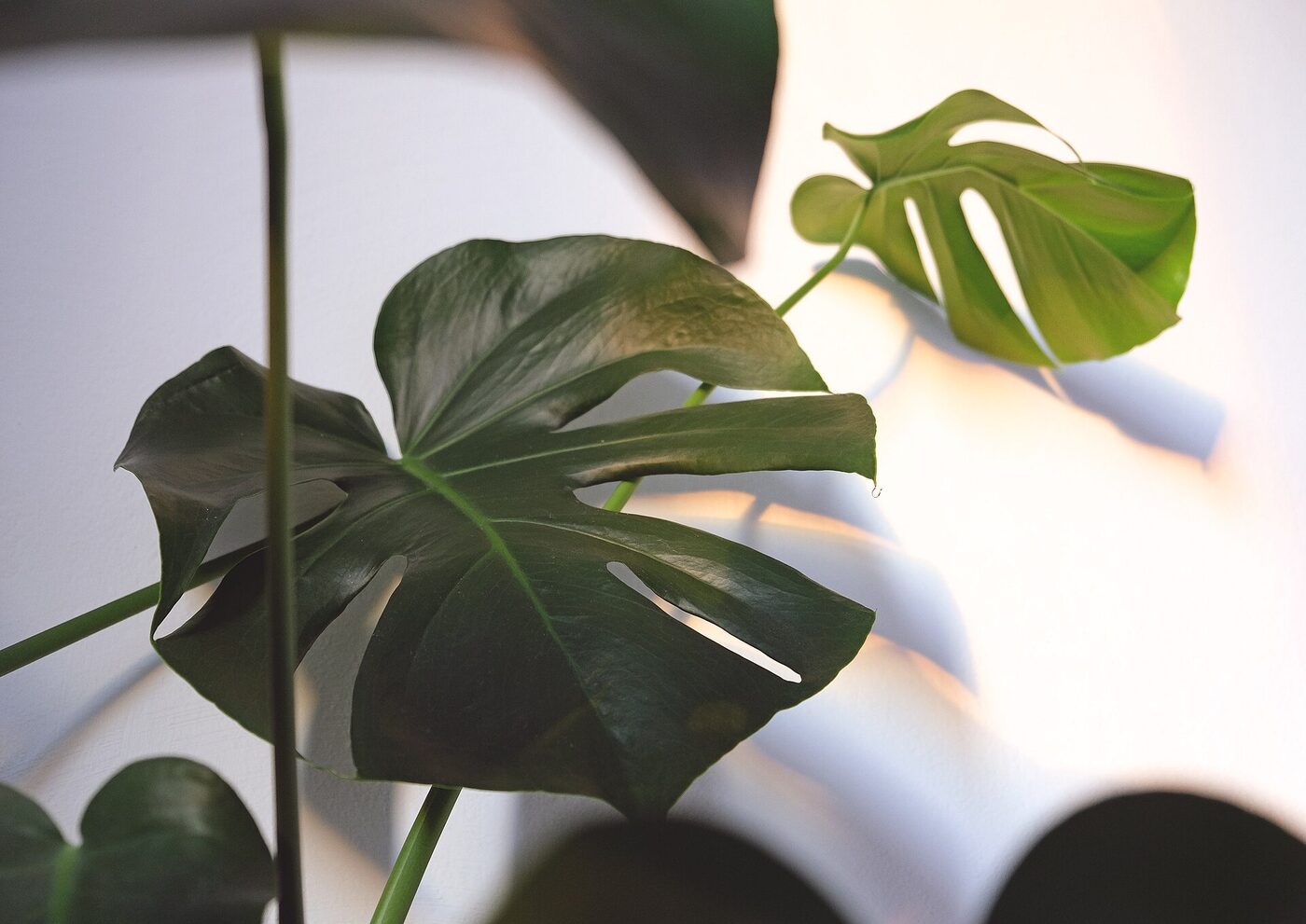
A real leaf, with real fenestration and a shadow that agrees with a single light source. Renders get all three of these subtly wrong.
The light rule, which is the whole subject
Almost every houseplant failure is a light failure, and light indoors falls off much faster than people expect. A spot half a metre from the glass and a spot two and a half metres back are not "both near the window". They are different climates.
The practical consequence is a small number of bands, and where a plant sits in those bands determines what can go there far more than any other factor.
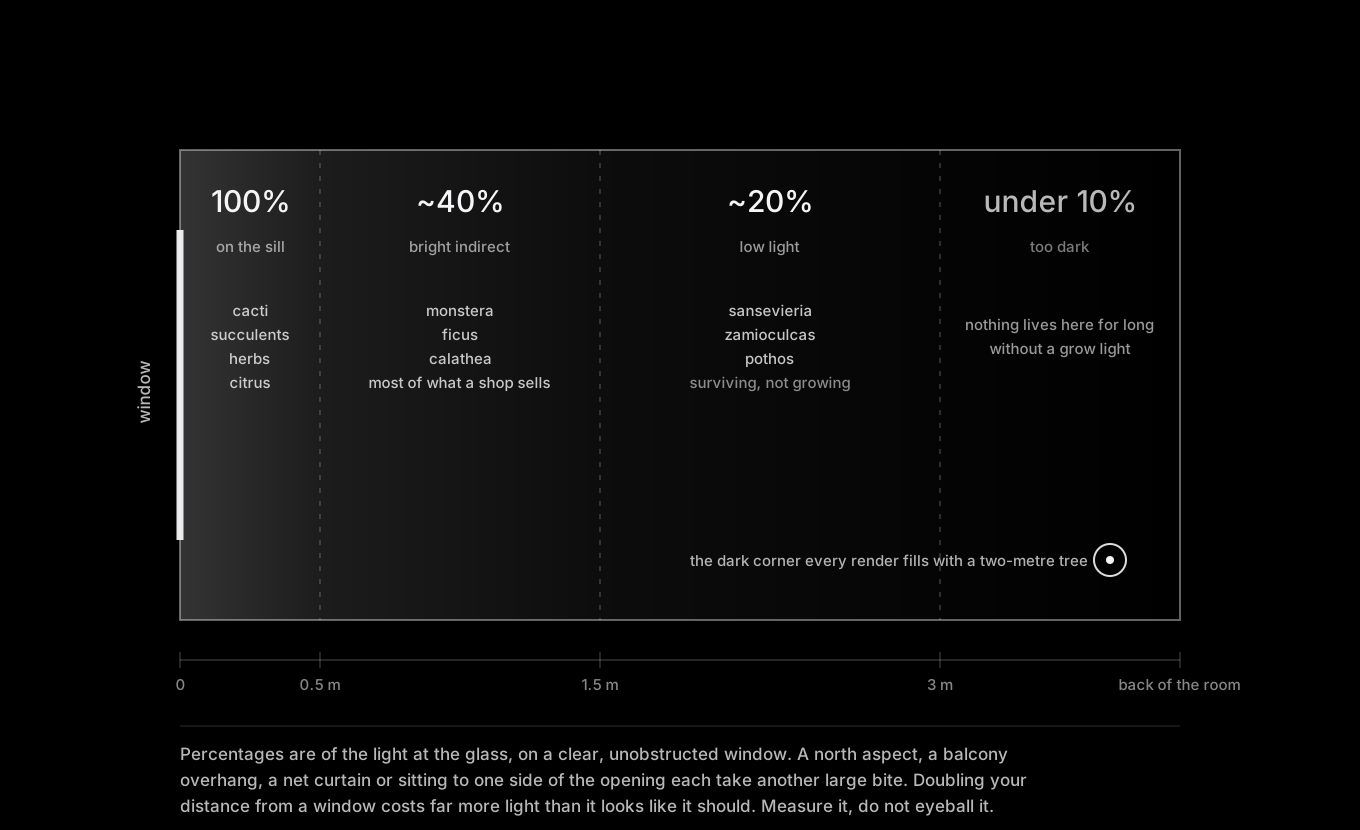
The bands that actually decide it. The marked corner at the back is the one every render fills with a large tree.
The corner marked on that diagram is worth dwelling on, because it is the single most common failure mode in AI interior design with plants. Compositionally, a room photograph has a dead zone: the corner furthest from the window, often beside a sofa or a door. It looks empty and unresolved. Every design instinct the model learned says put something tall and green there. It is also, reliably, the darkest square metre in the room. A two-metre fiddle leaf fig placed there will drop its lower leaves within a couple of months and be bare-stemmed by spring.
The honest options for that corner are a floor lamp, a tall narrow piece of storage, a large piece of art, a genuinely low-light plant like a sansevieria or zamioculcas that will merely persist, or a plant plus a grow light. What it is not is the tree in the render.
The other things renders get wrong about plants
Species that do not exist. Look closely at plants in AI renders and you will frequently find monstera fenestrations on a leaf with the wrong petiole, a rubber plant with ficus lyrata leaf shape, or a palm whose fronds emerge from a trunk no palm has. The model is blending. This matters practically, because you cannot go and buy the plant in the picture, and the one you do buy will have a different silhouette, a different density and a different growth habit.
Maturity. Renders show plants at their catalogue best: full, symmetrical, freshly wiped, at the size a nursery achieved over five years under glass. What arrives from a shop is smaller, sparser and one-sided, because it grew against a wall. If the render's composition depends on a plant being a certain size, price that size before you commit, because a mature specimen tree is often a three-figure purchase.
Pots without drainage. A hole in the base is invisible to a camera, so it does not exist to the model. Renders are full of beautiful sealed ceramic vessels with a plant sitting directly in them, which is the classic way to kill a plant by root rot. The real answer is almost always a plastic nursery pot inside a decorative cover pot, which is exactly as attractive from three feet away and is what most designed rooms actually do.
Pot proportion. The rough guide people in the trade use is that the pot should be about a third of the plant's total height, and when repotting you go up one size, roughly 2 to 4 cm of diameter, not three sizes. Renders regularly show a small plant in an enormous vessel, which looks striking and, in reality, holds a volume of wet soil the roots cannot use and turns sour.
Weight. A 30 cm terracotta pot with damp soil is easily 12 to 15 kg, and a large specimen in a concrete planter can pass 40. That is fine on a floor and worth a thought on a shelf, a windowsill in a rental, or a balcony with a load limit.
Toxicity. Renders do not know you have a cat. Monstera, pothos, philodendron, dieffenbachia, sago palm and lilies are all common in interior photography and all a problem in a house with pets or small children, lilies seriously so for cats. This is a filter to apply before the design conversation, not after.
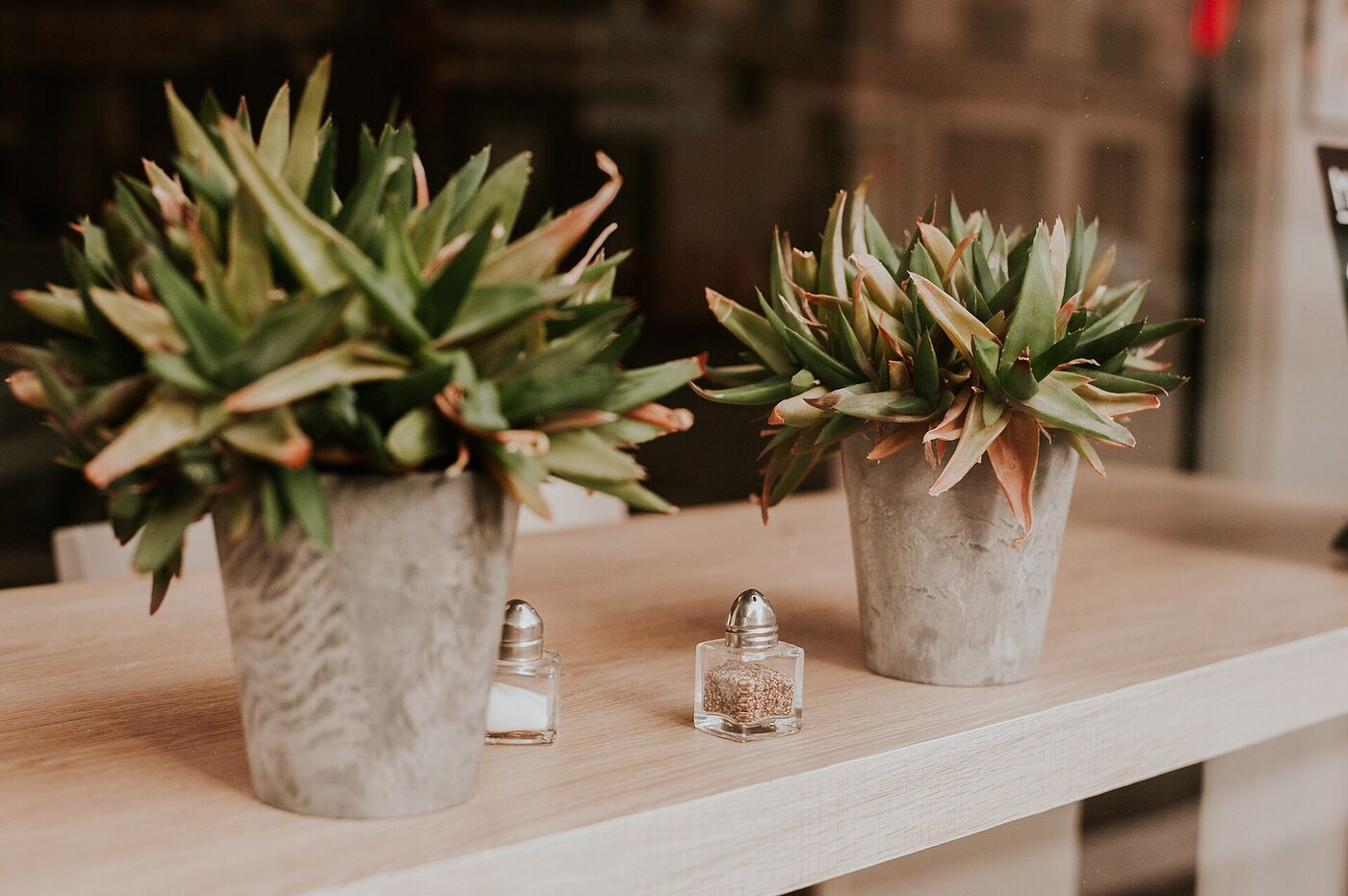
Cover pots doing the visual work while the plants live in plastic inside them. This is what most well-designed rooms actually do, and it is what renders never show.
The garden version of this makes the same trade-off visible: the planting scheme, massing and colour come across well, and every question about which species tolerates which position still belongs to you. Indoors the constraint is tighter, because a room has one light source and a garden has the sky.
Where a plant render earns its place
Quantity and rhythm. How much greenery a room can carry before it reads as cluttered is genuinely hard to picture and easy to see. Generating your own room with two plants, with five and with nine settles it quickly.
Scale of a statement plant. Whether a large plant belongs in that spot, and how large is large, is a proportion decision against your ceiling height and your furniture. Worth previewing before spending real money on a mature specimen.
Pots as a material decision. Terracotta, matte black, glazed, woven basket, concrete. Cover pots are one of the cheapest ways to change a room's character, and seeing them in your own space against your own floor is a fair test.
Where the greenery should go, given the light. This is the useful synthesis: work out your light bands first, then ask the tool to place plants only in the positions that survive, and judge the composition it produces. You are using it as a stylist working inside your constraints instead of as an oracle.
A render tells you what a room with plants in it looks like. Your window tells you which plants those can be. Do the window first.
A method that produces a room that stays alive
Stand at your window and pace the room. Mark, roughly, the half-metre line, the metre and a half line and the three metre line. Note which windows face which way, and knock the whole thing down a band if the window faces north or is obstructed by a balcony, a tree or a net curtain.
Photograph the room in daylight, restyle it, and then apply your bands as a filter to whatever the tool produced. Move any plant it placed beyond your three metre line, either to a better position or off the plan entirely. Replace anything you cannot identify with a real species you can actually buy in the size shown. Assume a cover pot rather than a sealed planter. Then check the shortlist against pets, and against how often you will realistically water something on a high shelf.
That process takes about twenty minutes and is the difference between a room that looks like the render for a fortnight and one that still looks like it a year later.
Questions people ask about AI and houseplants
Why does AI keep putting a big plant in my darkest corner?
Because compositionally that corner is a hole, and every design image the model learned from fills holes with greenery. It has no concept of light reaching that position. That corner is usually the darkest place in the room, so the render is proposing the one spot where the plant is least likely to live. More detail in can AI tell me if a plant will survive where it puts it.
Can I buy the plant I see in an AI render?
Often not, because it is not a real species. Models blend leaf shapes across genera, so you get monstera fenestrations on the wrong stem or a palm with an impossible trunk. Identify the closest real plant you can actually source, and expect a smaller, sparser, less symmetrical specimen than the render showed.
Is AI useful for choosing planters and pots?
Yes, this is one of its better uses. Pot material and colour are a real design lever and a cheap one, and seeing terracotta against matte black against a woven basket in your own room is a fair comparison. Just assume you will use a cover pot with a nursery pot inside it, because renders never draw a drainage hole.
How do I know how much light a spot in my room gets?
Pace it out from the window and treat half a metre, a metre and a half and three metres as your bands, then downgrade a band for a north aspect, an overhang, a tree outside or a net curtain. If you want to be exact, a light meter app on a phone is imprecise in absolute terms but perfectly good at comparing two spots in the same room on the same day.
The short version: greenery is the part of a render that costs the least to add and the most to get wrong, because it is the only element in the picture that can die. Use AI for the questions with visual answers, which are how many, how big, and in what pot. Answer the one question that matters, which is how much light reaches that spot, by walking across your own room.
Image credits: "Indoor Monstera deliciosa" by kallerna, licensed CC BY-SA 4.0; "Plants on wooden shelf" by Anete Lūsiņa, released under CC0, via Wikimedia Commons. Diagram by MeltFlex Solutions.